Worth Visiting
Cheonggyecheon Stream Plaza
Mikyoung Kim Design / Seoul Metropolitan Government · 2005
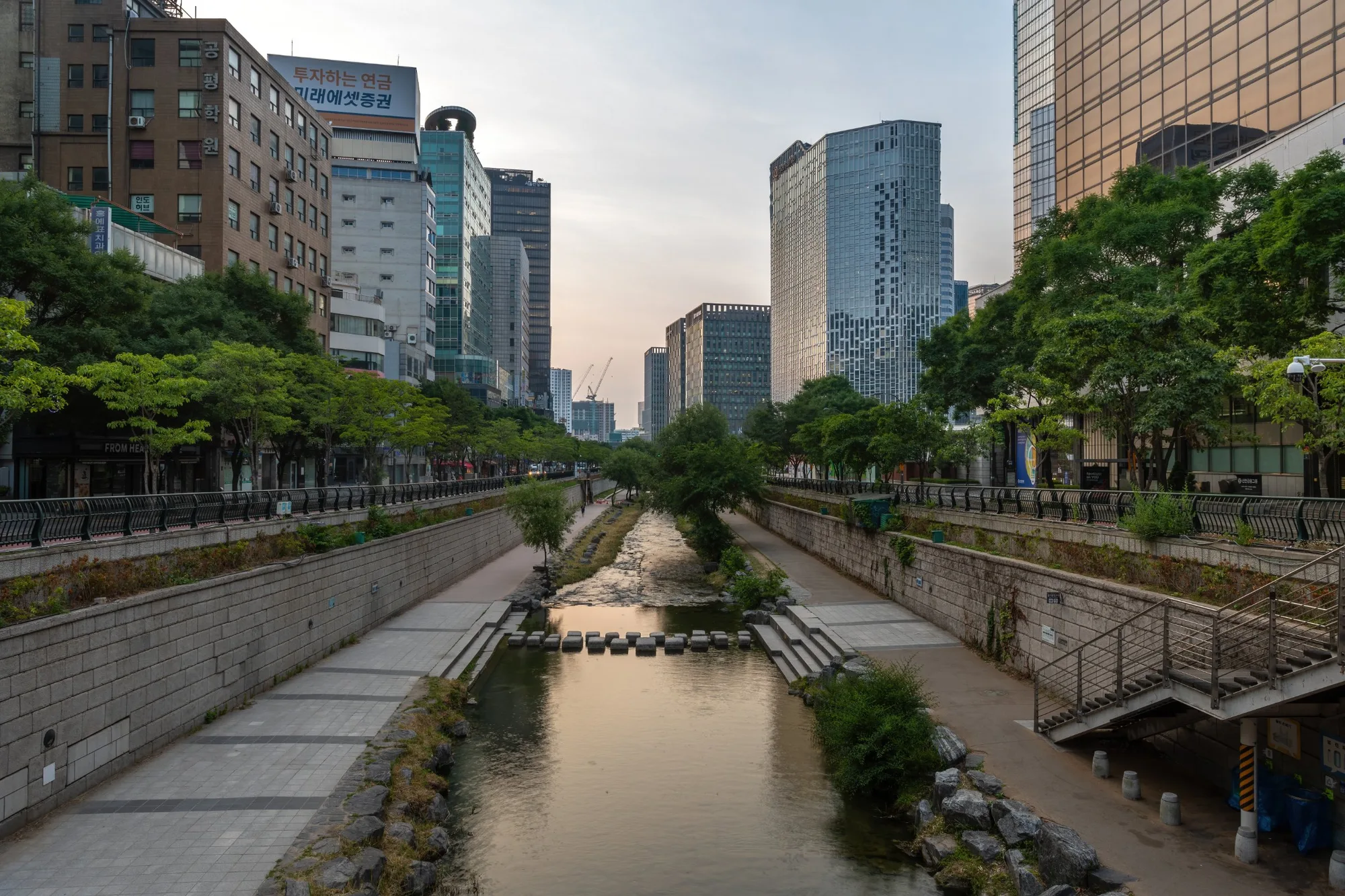
FIG. 01
ArchitectMikyoung Kim Design / Seoul Metropolitan Government
Year2005
LocationSeoul, South Korea
Coordinates37.5696° N, 126.9769° E
TypePublic Space · Urban Intervention, Landscape · Waterfront Landscape
StatusWorth Visiting
Sign in to save and check in to this place.
About this place
Seoul's 6 km restored stream — a former highway demolished to uncover a buried waterway running from City Hall through the heart of the city, lined with art installations and public terraces.
Cheonggyecheon was buried in the 1960s to make way for an elevated expressway — one of the definitive acts of Korean modernisation-at-speed. In 2003 that expressway was demolished and the stream restored at grade, creating a 5.8-kilometre linear park that cuts through the densest part of central Seoul from Cheonggye Plaza at the western end to Sindap Expressway in the east.
The source plaza is the most architecturally designed section: a semicircular pool where the water originates from two large sculptural waterfalls, flanked by a curving mosaic wall referencing a Joseon-era map of Seoul. The plaza is surrounded by major civic and commercial architecture — the old and new Seoul City Hall buildings face each other a short walk north — and functions as a gathering point for the city's public life.
Downstream, the stream drops to a level several metres below street grade, creating a sheltered green corridor of stepping stones, bridges, and planted banks that reads as a continuous outdoor room rather than a park. The temperature differential between the stream-level and the surrounding traffic creates a microclimate measurably cooler than the surrounding city, and the corridor is used daily by workers from the adjacent business district.
The project is sometimes cited as proof of urban de-infrastructuring — but its success depends as much on what it is (a linear public space with real programming and constant footfall) as on what it replaced. Visit early morning or at dusk, when the LED lighting activates across the bridges and the noise of the surrounding city is less present.
Public Space · Urban InterventionLandscape · Waterfront Landscape
More in SeoulAll →
Comments
Sign in to leave a comment.
Access conditions may change. Please check current opening and access information with the venue before visiting.
Something wrong or missing?