Worth Visiting
Elbphilharmonie
Herzog & de Meuron · 2017
ArchitectHerzog & de Meuron
Year2017
LocationHamburg, Germany
Coordinates53.5413° N, 9.9841° E
TypeCulture · Performance Space, Architecture · Contemporary Architecture
StatusWorth Visiting
Sign in to save and check in to this place.
About this place
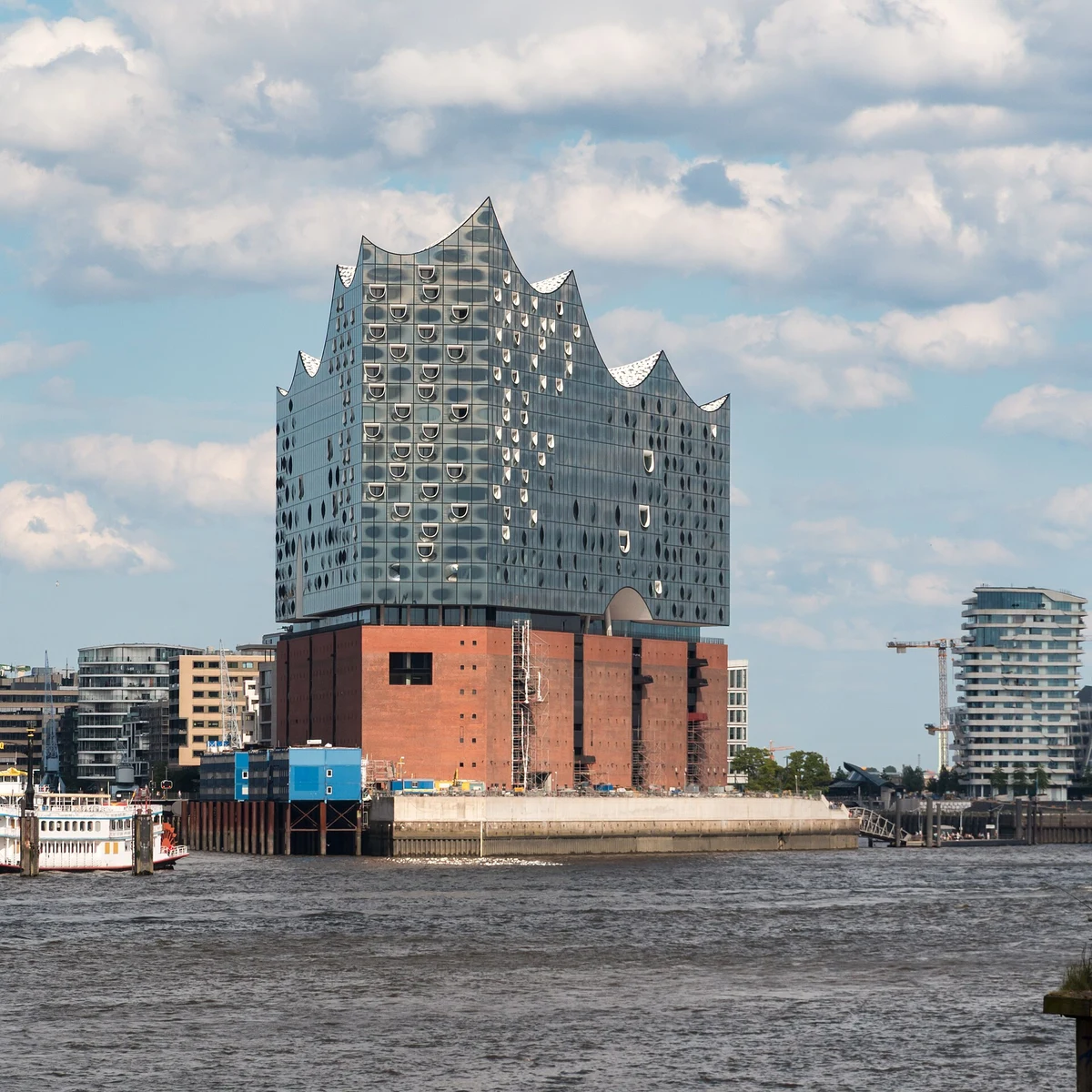
Herzog & de Meuron’s 2017 Hamburg landmark — a rippling glass crown set on a 1960s brick warehouse, holding a vineyard-style concert hall and a public plaza with harbour views.
The Elbphilharmonie, completed in 2017 by Herzog & de Meuron, has become the symbol of contemporary Hamburg. The architects set a shimmering, wave-topped glass structure directly on top of the Kaispeicher A, a robust 1960s brick warehouse on the tip of HafenCity surrounded by the Elbe on three sides. The seam between old brick base and new glass crown is marked by the ‘Plaza’, a public viewing level reached by a long curved escalator, open to anyone and offering a panorama of the harbour and city.
Above the plaza rises the Grand Hall, a 2,100-seat auditorium arranged as a steep ‘vineyard’ of terraces wrapping entirely around the stage, its surfaces clad in some ten thousand individually milled gypsum-fibre panels — the ‘white skin’ — tuned acoustically by Yasuhisa Toyota. The curving glass façade panels, each printed and partly bulged, catch the changing light of sky and water so the building never looks the same twice. Long delayed and famously over budget, it has nonetheless earned its place among the defining concert buildings of its era.
Culture · Performance SpaceArchitecture · Contemporary Architecture
Comments
Sign in to leave a comment.
Access conditions may change. Please check current opening and access information with the venue before visiting.
Something wrong or missing?