Must Visit
Igreja de Santo António
João Luís Carrilho da Graça · 2008
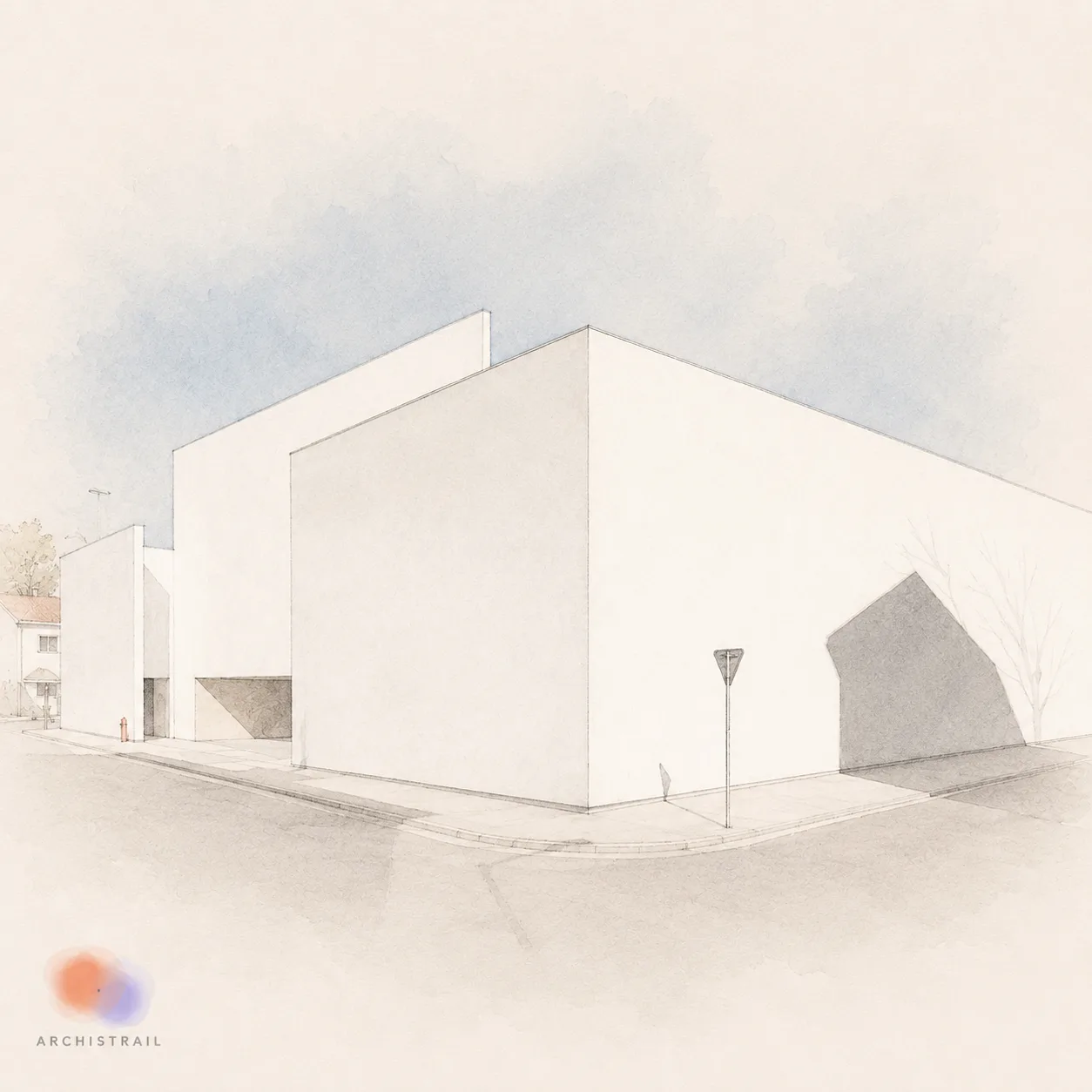
FIG. 01
ArchitectJoão Luís Carrilho da Graça
Year2008
LocationPortalegre, Portugal
Coordinates39.2843° N, 7.4314° W
TypeArchitecture · Religious Building
StatusMust Visit
Sign in to save and check in to this place.
About this place
Carrilho da Graça's 2008 church in Portalegre — pure white cubic volumes with a dramatic arched void carved into the corner, inserting a rigorously abstract sacred space into a peripheral Portuguese neighbourhood.
The Igreja de Santo António e Centro Social de São Bartolomeu, completed in 2008 in the Assentos neighbourhood of Portalegre, is one of João Luís Carrilho da Graça's most admired works. On a modest corner site at the edge of a residential district, the building presents as a sequence of white cubic volumes, stripped of ornament — the only relief provided by cut geometries that mark the entrances and announce the interior's volumetric complexity.
The key move is the arched void: a tunnel-like opening carved through the corner of the main volume, its curved soffit meeting the right-angle of the building's skin. This is not decoration but structural logic made legible. The gesture is simultaneously ancient and rigorously modern, recalling the ecclesiastical stone arches of the Alentejo region while operating entirely within the language of abstract form.
Inside, the church is austere without being cold: white plaster walls, concrete floor, a single side-lit aperture that washes the altar wall in diffuse, sourceless light. The section is carefully managed — the nave rises to a controlled height, the roof plane angled to direct light without revealing its origin. The spatial effect is meditative and precise.
The social centre adjoining the church follows the same logic: white volumes, clean geometry, shadow as the primary ornament. Together they form a small civic composition that takes the peripheral site seriously rather than treating it as a constraint. One of the more accomplished religious buildings in contemporary Portuguese architecture, and largely unknown outside specialist circles — which makes a visit all the more worthwhile.
Architecture · Religious Building
Comments
Sign in to leave a comment.
Access conditions may change. Please check current opening and access information with the venue before visiting.
Something wrong or missing?