Worth Visiting
Museum Liaunig
Querkraft · 2008
ArchitectQuerkraft
Year2008
LocationNeuhaus, Austria
Coordinates46.6460° N, 14.8908° E
TypeCulture · Museum, Architecture · Museum Building
StatusWorth Visiting
Sign in to save and check in to this place.
About this place
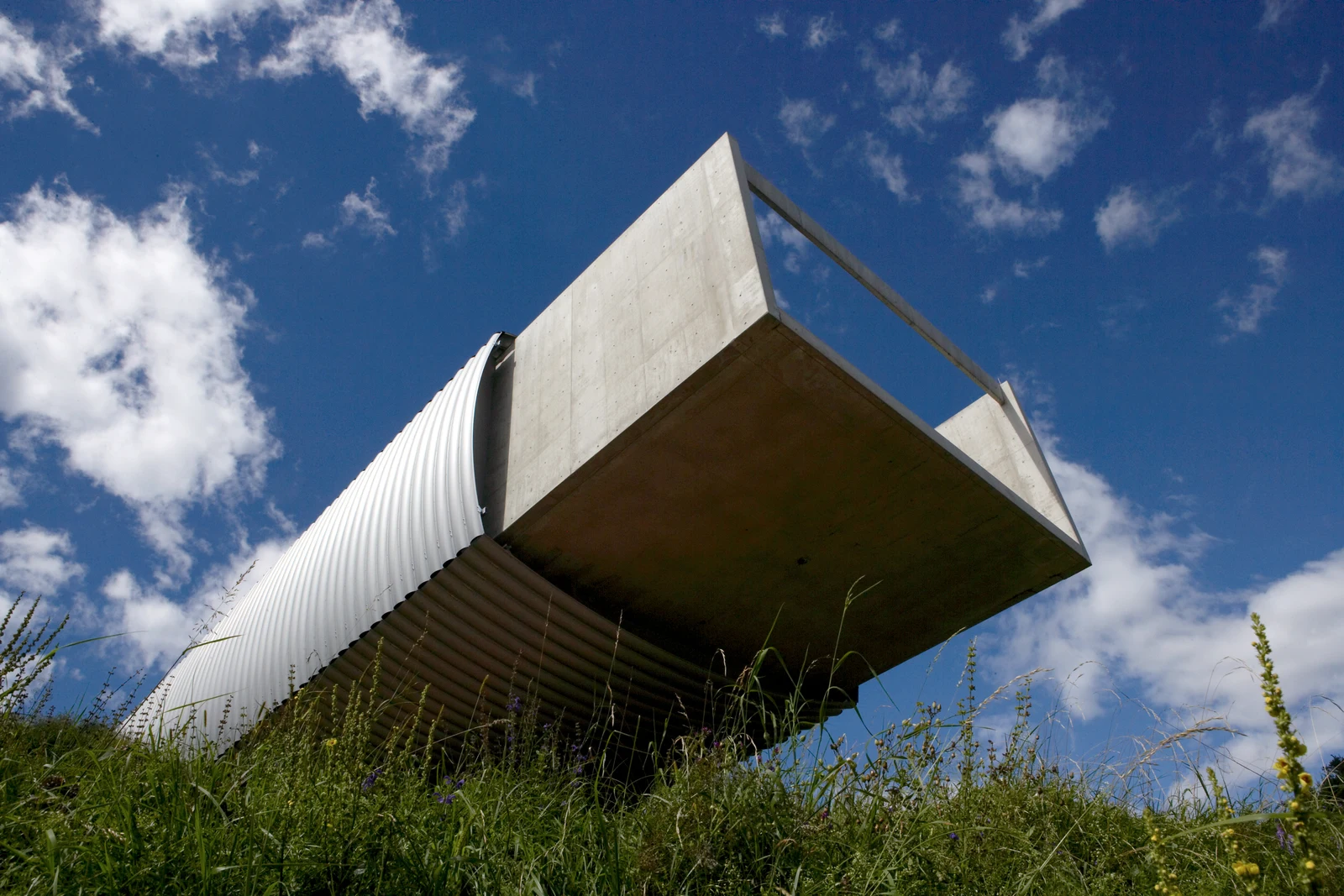
Underground tube museum by Querkraft (2008), carved into a Carinthian hillside. A 160m concrete hall cantilevers over the Drava Valley, housing Austria's largest private art collection.
Museum Liaunig sits embedded in the hillside terrain of southeastern Carinthia, a few kilometres from the Drava River. The museum was commissioned by collector Herbert W. Liaunig and completed by Viennese practice Querkraft in 2008, with a significant extension added in 2015.
The primary exhibition space is a single 160-metre-long, 13-metre-wide concrete tube — a volume that appears to hover above the valley floor when viewed from the approach road. The tube is set mostly underground, reducing both construction cost and heating load while keeping the surrounding landscape undisturbed. Roof windows cut along the length of the hall provide natural light that shifts throughout the day, picking out the surfaces of the works without the flatness of artificial lighting. At either end, the tube opens with large glazed terraces commanding wide views across the valley.
The 2015 extension added a triangular hall for temporary exhibitions, further underground rooms for the glass and miniature collection, and a circular sculpture storage space visible to visitors through glass enclosures. The storage, a relatively unusual curatorial decision, invites visitors to understand the collection as a living archive rather than a static display.
Inside, the collection spans approximately 3,000 works of Austrian contemporary art from 1950 to the present — one of the largest privately held bodies of such material — alongside African gold and jewelry objects from the Akan culture. The shift from the sunlit tube to the dimly lit African galleries below is among the more disorienting and memorable transitions the building stages.
Outside, a sculpture park and café extend the visit into the landscape, where the museum's most visible gesture — the projecting concrete tube — reads as a piece of infrastructure adapted for contemplation rather than transit. It is a rare example of a private museum whose ambition is matched by its architecture.
Culture · MuseumArchitecture · Museum Building
Nearby places
More in NeuhausAll →
No other places in Neuhaus yet.
Comments
Sign in to leave a comment.
Access conditions may change. Please check current opening and access information with the venue before visiting.
Something wrong or missing?