Worth Visiting
Oil Tank Culture Park
RoA Architects · 2017
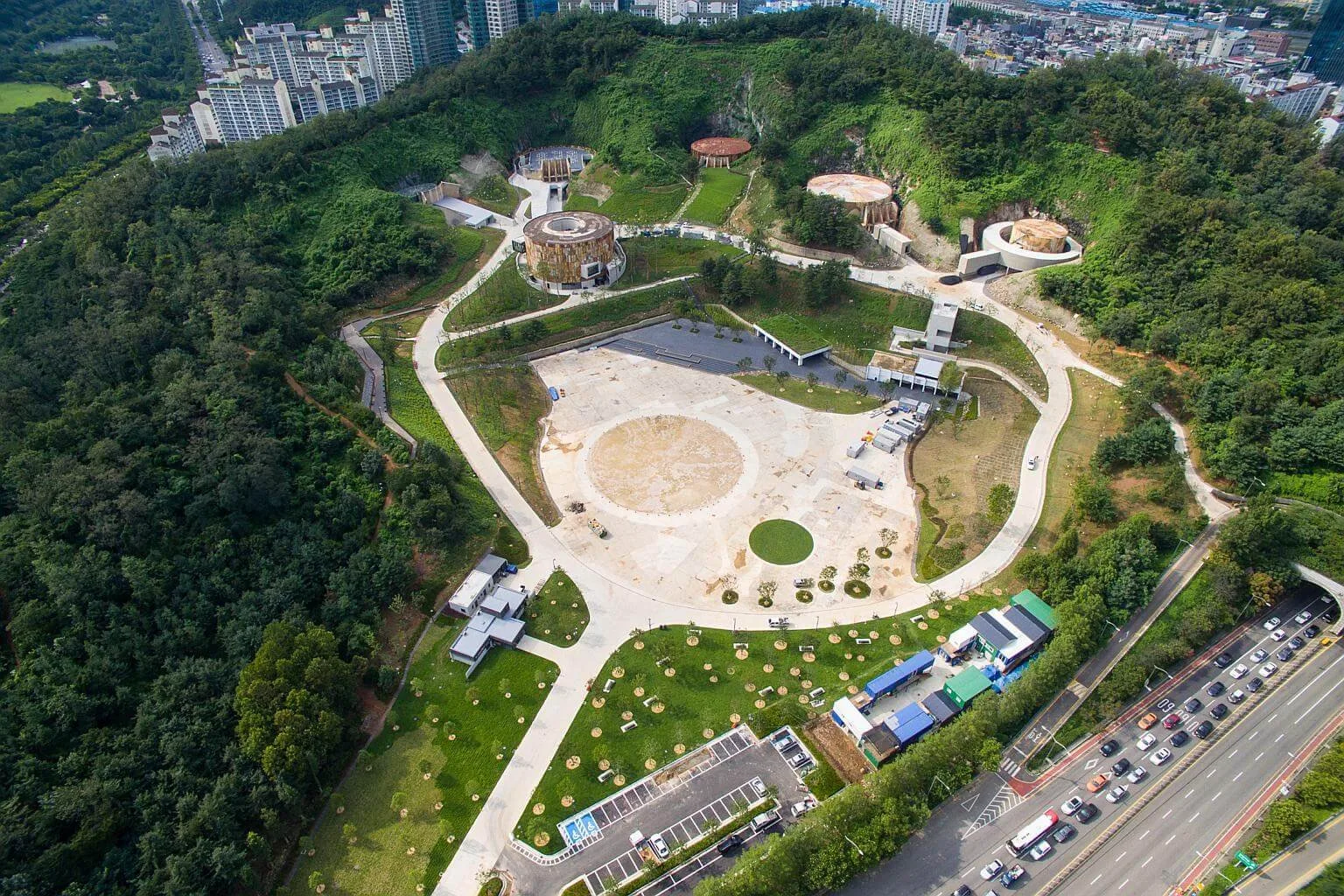
FIG. 01
ArchitectRoA Architects
Year2017
LocationSeoul, South Korea
Coordinates37.5708° N, 126.8942° E
TypeArchitecture · Adaptive Reuse, Culture · Cultural Center, Public Space · Urban Intervention
StatusWorth Visiting
Sign in to save and check in to this place.
About this place
Six disused 1970s oil tanks on the edge of Seoul's World Cup Park, transformed by RoA Architects into an open cultural complex — industrial vessels preserved in full and threaded through with new public space.
Oil Tank Culture Park occupies a site on the slope of Maebongsan hill in Mapo-gu that was sealed off for more than four decades. During the 1970s oil crisis, the Korean government built six large above-ground oil storage tanks here as strategic reserve; the tanks were decommissioned in 2002, after which the site remained fenced and inaccessible to the public.
In 2013, the Seoul Metropolitan Government ran an international design competition to transform the site into a cultural facility. The winning proposal, titled "Petro: Reading the Story of the Site," was submitted by RoA Architects. The strategy was deliberately conservative toward the industrial infrastructure: the six tanks were kept intact as found objects and primary spatial elements, with new programme inserted into and between them rather than replacing them. The tanks range in size from a 38-metre-diameter elliptical water pavilion tank to smaller cylindrical volumes. Each has been given a distinct character and programme — exhibitions, performances, outdoor cinema, community kitchen, café, and gathering space.
The park opened to the public in September 2017 and received the 2018 Seoul Urban Regeneration Award. The intervention connects the tank field to the adjacent World Cup Park via a new topographic landscape that threads paths through the hillside. The relationship between the corroded steel tanks and the new lightweight steel and glass insertions within them is the project's central architectural proposition: preservation as a form of display, industry as a readymade cultural infrastructure.
The park is freely accessible and hosts a continuous programme of markets, film screenings, and exhibitions. It is one of the most visited architectural sites in Seoul outside the historical palaces.
Architecture · Adaptive ReuseCulture · Cultural CenterPublic Space · Urban Intervention
More in SeoulAll →
Comments
Sign in to leave a comment.
Access conditions may change. Please check current opening and access information with the venue before visiting.
Something wrong or missing?