Worth Visiting
Samsung Child Education and Culture Center
OMA / Rem Koolhaas · 2004
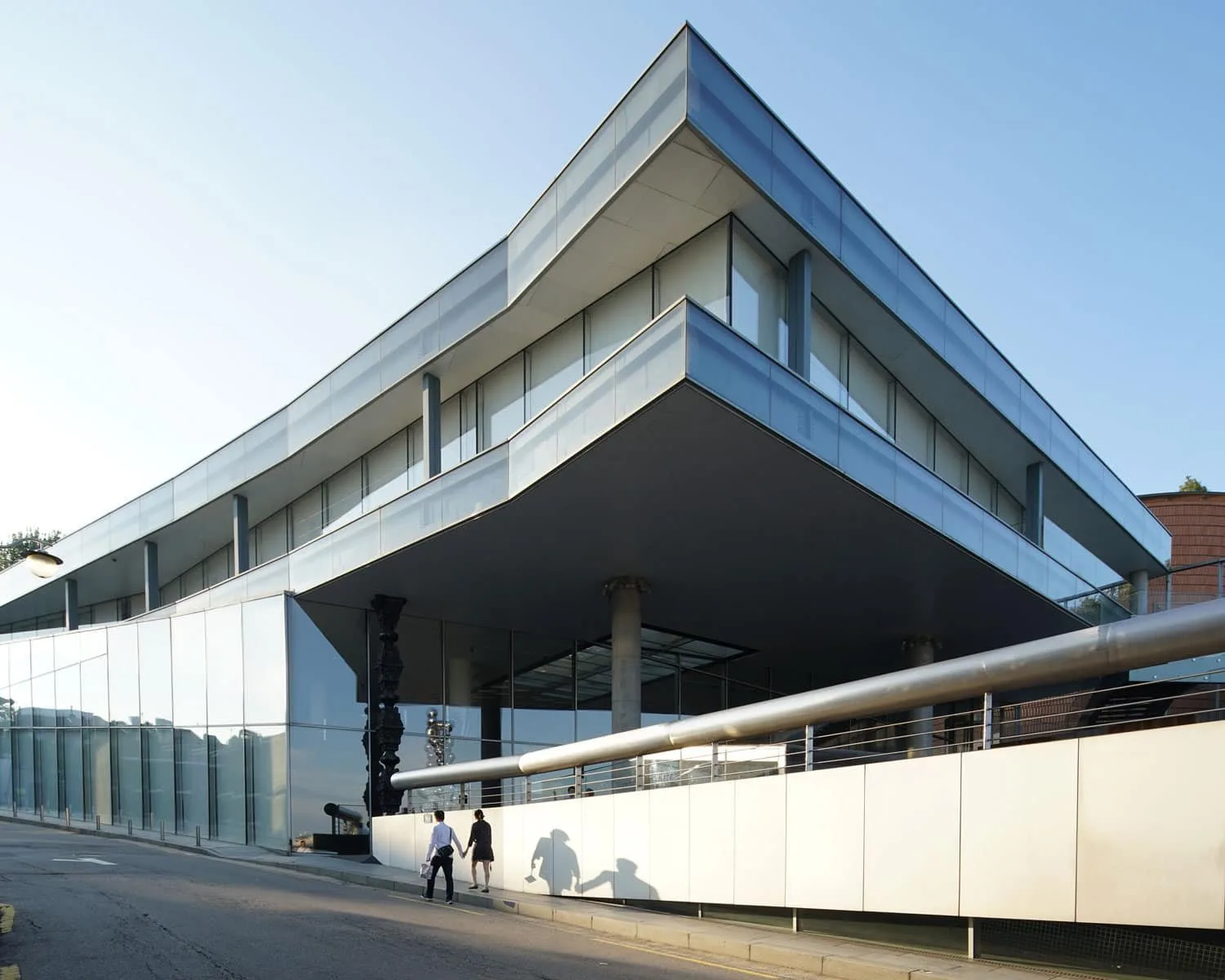
FIG. 01
ArchitectOMA / Rem Koolhaas
Year2004
LocationSeoul, South Korea
Coordinates37.5381° N, 126.9981° E
TypeCulture · Cultural Center, Architecture · Contemporary Architecture
StatusWorth Visiting
Sign in to save and check in to this place.
About this place
OMA's contribution to the Leeum complex — a stacked metallic volume housing temporary exhibitions, education spaces, and offices, completing Koolhaas's 1997 masterplan.
The Samsung Child Education and Culture Center is Rem Koolhaas and OMA's contribution to the Leeum Samsung Museum of Art, one of Seoul's most architecturally significant cultural complexes. Completed in 2004, the building was the last of three structures to open on a steep Hannam-dong hillside, alongside Mario Botta's Museum 1 (traditional Korean art) and Jean Nouvel's Museum 2 (contemporary art).
OMA's building is the most formally assertive of the three: a dark, metallic mass that appears to hover above the landscape, its volumes stacked and offset with characteristic Koolhaasian disregard for tectonic convention. At 13,100 square metres, it houses temporary contemporary art exhibitions on the upper floors, with media spaces, offices, and the children's education and culture program below — a deliberately mixed programme that resists the monolithic museum type.
Where Botta's building is rooted in masonry tradition and Nouvel's in reflective technological precision, OMA's contribution introduces spatial ambiguity and conceptual density. The exterior reads as a compressed urban block — opaque panels and apertures placed in deliberate tension — while the interior circulation moves through a succession of varied-height exhibition volumes with unexpected sectional shifts.
The masterplan itself, conceived by OMA in 1997, choreographs the three buildings across a sloping site that descends from the street, creating terraced plazas, a central gathering space, and pedestrian routes that tie the complex together. The result is not a campus but a dense, compressed ensemble — closer in spirit to a city block than a museum park.
The Samsung Child Education and Culture Center rewards careful attention: the building's apparent simplicity conceals a layered spatial logic that only reveals itself through movement. Visit on a weekday for quieter access to the building's circulation and perimeter.
Culture · Cultural CenterArchitecture · Contemporary Architecture
More in SeoulAll →
Comments
Sign in to leave a comment.
Access conditions may change. Please check current opening and access information with the venue before visiting.
Something wrong or missing?