Worth Visiting
Carmo Convent Ruins
Unknown (Gothic, founded 1389) · 1755
ArchitectUnknown (Gothic, founded 1389)
Year1755
LocationLisbon, Portugal
Coordinates38.7120° N, 9.1406° W
TypeArchitecture · Historic Architecture, Culture · Museum
StatusWorth Visiting
Sign in to save and check in to this place.
About this place
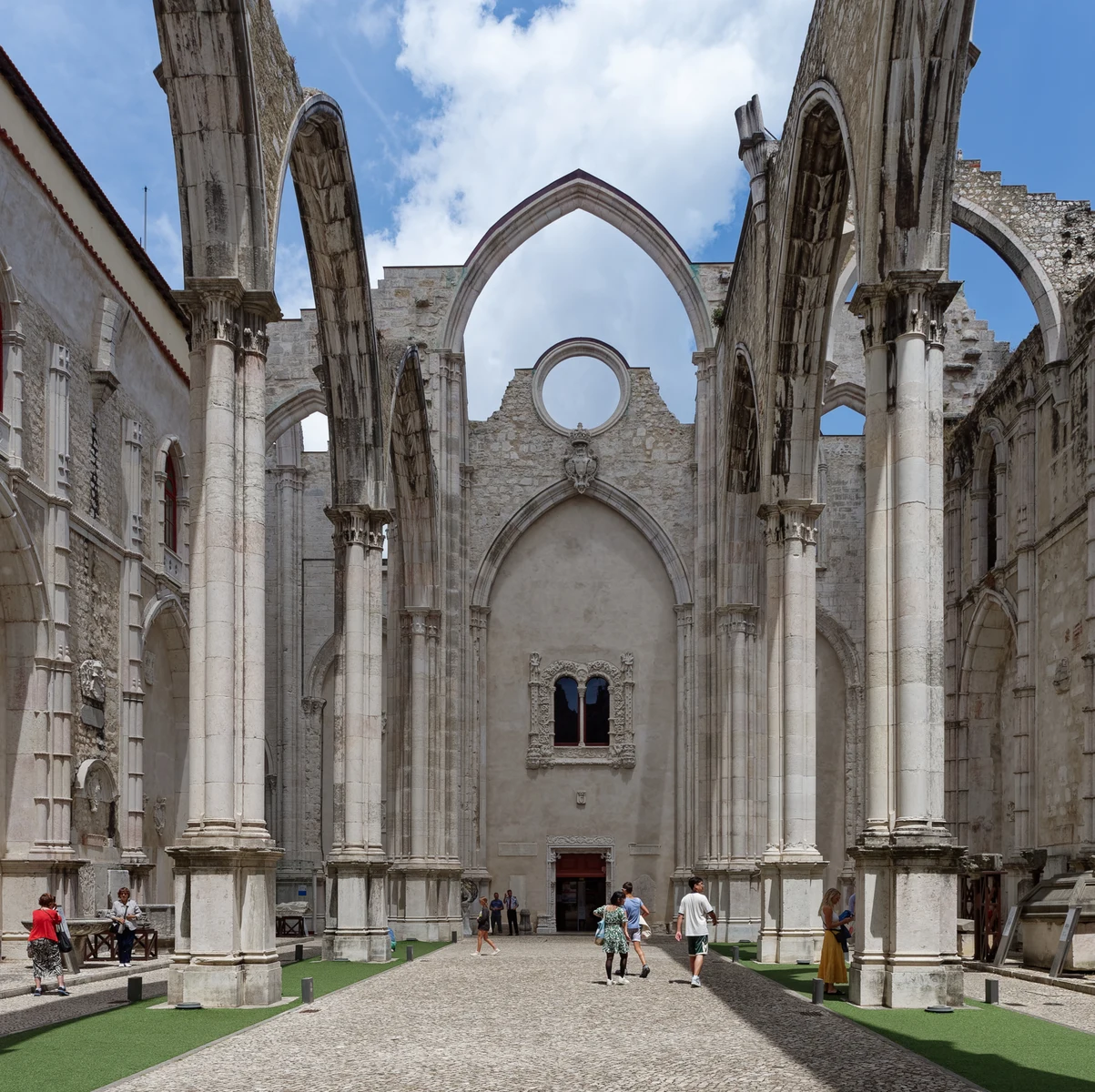
A roofless Gothic church left exactly as the 1755 earthquake destroyed it — Lisbon's most visceral, unrestored monument to the disaster that reshaped the city.
Founded in 1389 by the Constable Nuno Álvares Pereira, the Carmo Convent was once among the largest and most important Gothic churches in Lisbon. On All Saints' Day, 1 November 1755, a catastrophic earthquake estimated at magnitude 8.5–9.0 struck the city, followed by fires and a tsunami, killing tens of thousands and destroying much of Lisbon's historic fabric. The Carmo Church's stone vaulted roof collapsed in the earthquake and, uniquely among the city's damaged monuments, was deliberately never rebuilt.
What remains today is one of the most haunting sights in Lisbon: a full Gothic nave and chancel, its pointed stone arches standing bare against open sky, the tracery and ribs of a vaulted ceiling that no longer exists still legible in outline. Walking beneath these skeletal arches, with the sky visible where a ceiling should be, gives a far more visceral sense of the earthquake's violence than any restored building could. The choice to preserve the ruin as a ruin — rather than rebuild it, as much of the rest of the city eventually was — makes it Lisbon's most direct physical memorial to the disaster that reshaped both the city and, through the reconstruction effort led by the Marquis of Pombal, the modern practice of urban planning and seismic engineering.
The surviving chancel now houses the small Carmo Archaeological Museum, displaying artefacts recovered from the site and beyond, but the emptied nave itself — used today for concerts and exhibitions under open sky — remains the main event. Located in the Chiado district, it's an easy, essential stop for anyone trying to understand Lisbon's history rather than just its postcard views.
Architecture · Historic ArchitectureCulture · Museum
Nearby places
More in LisbonAll →
Comments
Sign in to leave a comment.
Access conditions may change. Please check current opening and access information with the venue before visiting.
Something wrong or missing?