Visit if Near
Centro Torri
Aldo Rossi · 1988
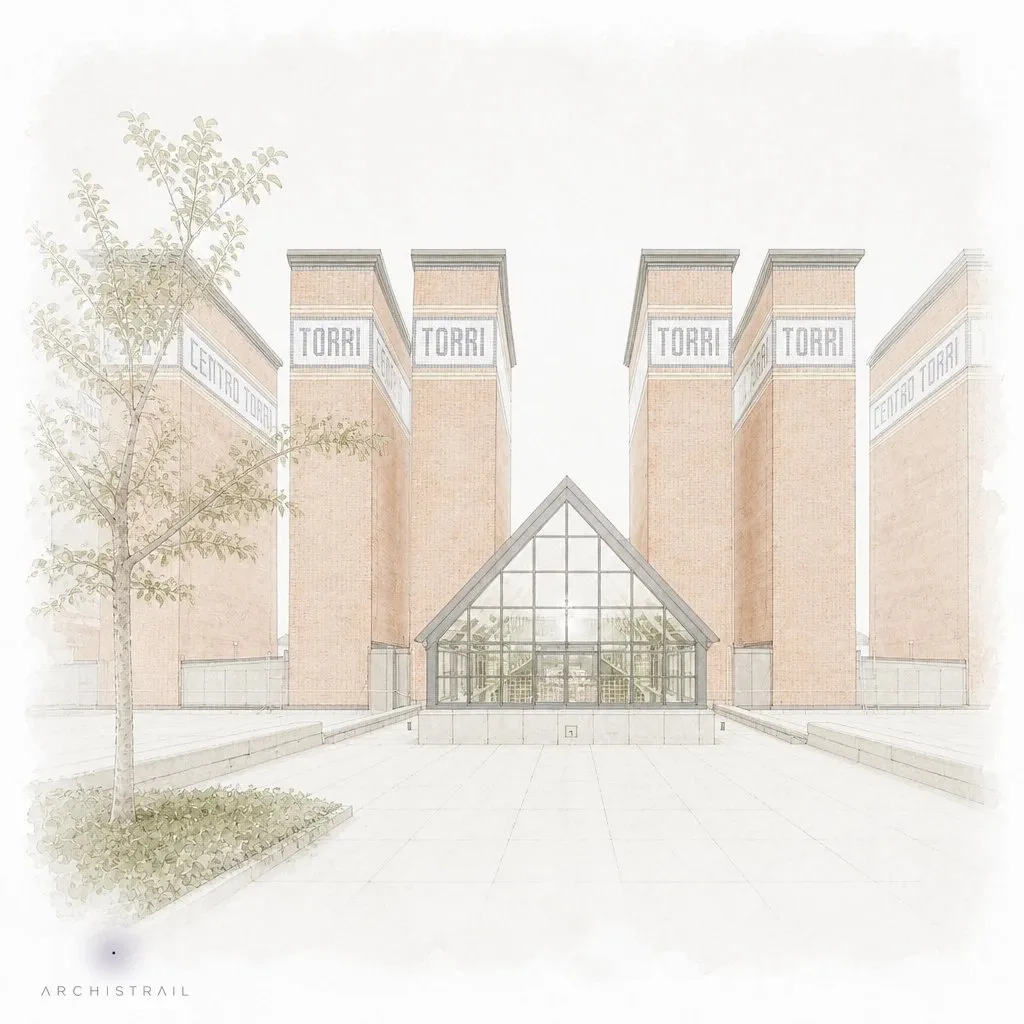
FIG. 01
ArchitectAldo Rossi
Year1988
LocationParma, Italy
Coordinates44.8232° N, 10.3378° E
TypeRetail, Architecture · Landmark
StatusVisit if Near
Sign in to save and check in to this place.
About this place
One of Italy's first shopping centers, designed by Aldo Rossi as a postmodern civic composition of towers and arcades rather than a conventional mall.
Completed in 1988, Centro Torri was among the first purpose-built shopping centers in Italy, and a rare instance of a major postmodern theorist — Aldo Rossi — applying his architectural language to an explicitly commercial, suburban building type. Rather than the anonymous big-box sheds typical of the genre, Rossi organized the complex around a composition of towers, colonnades, and a central covered gallery, borrowing the formal vocabulary of Italian civic architecture — town halls, market halls, medieval towers — and redeploying it for retail.
The exterior reads as a small fortified town more than a mall: brick towers punctuate the roofline, arcaded walkways wrap the perimeter, and the massing is broken into legible, discrete volumes rather than a single undifferentiated box. Inside, the same logic continues with a top-lit central spine flanked by shopfronts, referencing the historic Italian galleria typology (as in Milan's Galleria Vittorio Emanuele II) at a much more modest, suburban scale.
Centro Torri is a useful counterpoint to Rossi's more austere, monumental works like the San Cataldo Cemetery — proof that his interest in typology and the 'analogous city' extended even into a building type usually treated as purely commercial and disposable. For visitors tracing Rossi's built work across Emilia-Romagna, it's a short, easy stop that shows a different, more everyday register of his architecture.
RetailArchitecture · Landmark
Nearby places
More in ParmaAll →
Comments
Sign in to leave a comment.
Access conditions may change. Please check current opening and access information with the venue before visiting.
Something wrong or missing?