Worth Visiting
Monument to Sandro Pertini
Aldo Rossi · 1990
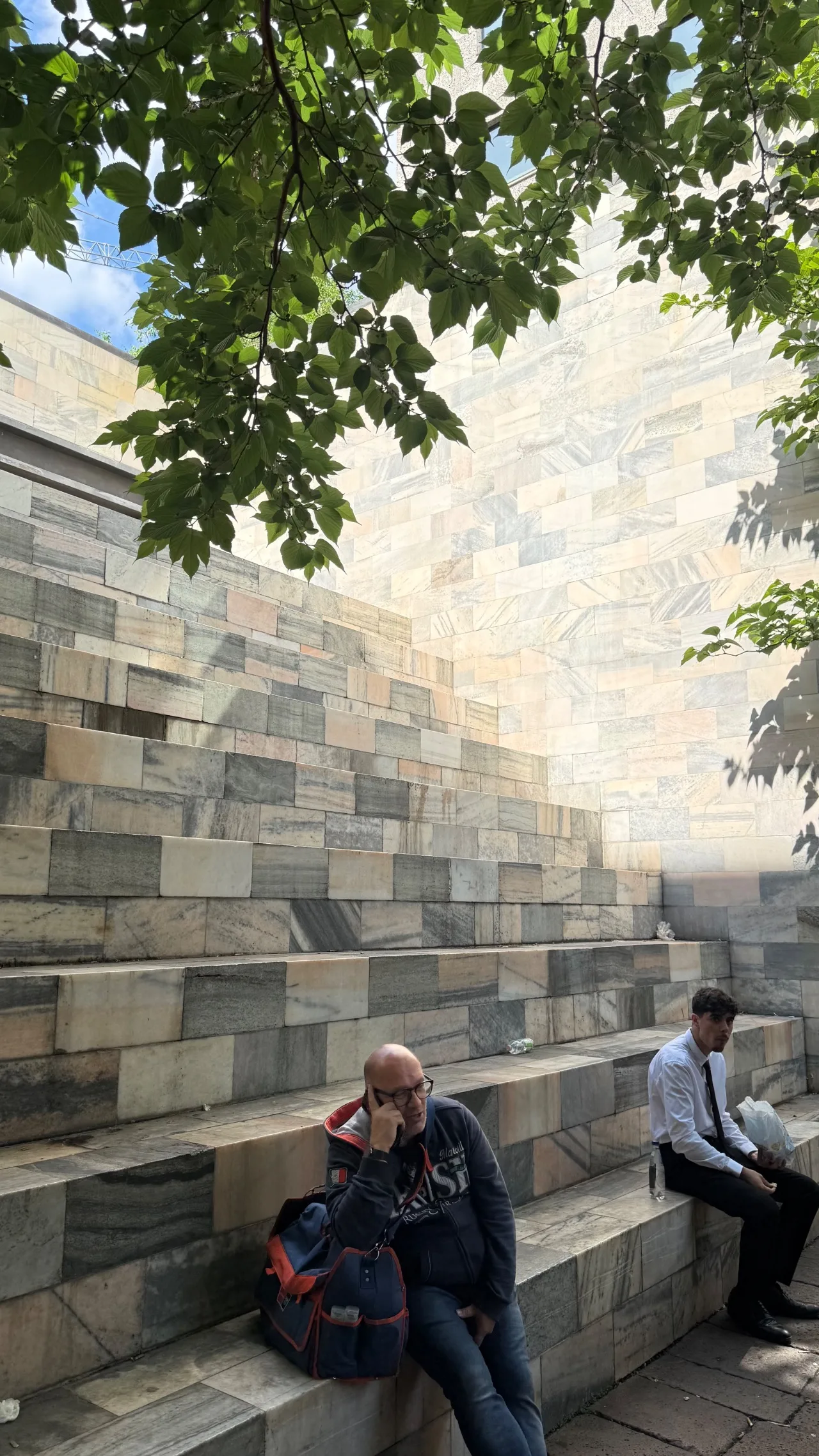
FIG. 01
ArchitectAldo Rossi
Year1990
LocationMilan, Italy
Coordinates45.4703° N, 9.1926° E
TypePublic Space · Memorial, Architecture · Contemporary Architecture
StatusWorth Visiting
Sign in to save and check in to this place.
About this place
Aldo Rossi’s 1990 fountain-monument to former Italian president Sandro Pertini — a stepped cube of pink Candoglia marble, the same stone as the Duomo, anchoring a small piazza off Via Montenapoleone.
Inaugurated in 1990 to a 1988 design, Aldo Rossi’s monument to Sandro Pertini — wartime partisan, journalist and the much-loved seventh President of the Italian Republic — stands at the pedestrian end of Via Croce Rossa, where Via Montenapoleone meets Via Manzoni in the heart of Milan’s Brera quarter. Rossi, a leading figure of the Tendenza and author of the 1966 book “The Architecture of the City,” refused the conventional bronze effigy. Instead he built a small fragment of city: a quiet Lombard piazzetta of mulberry trees, stone benches, lamp posts and pink-granite paving gathered around a single primary form.
That form is a stepped fountain-cube roughly eight metres on each side, built to a strict fifty-centimetre module from blocks of Candoglia marble — the greyish-pink stone of Milan Cathedral, drawn from the same Veneranda Fabbrica del Duomo quarry. A podium closed on three sides frames a triangular channel down which water slides to a shallow basin, with details picked out in copper alloy. The cube reads at once as stair, altar, fountain and tomb: Rossi’s recurring “analogous” geometry, in which elementary shapes carry layered civic memory.
Compact and deliberately austere, the monument compresses memorial, architecture and everyday public space into one object you can sit on and walk through. It has divided Milanese opinion since it opened — too abstract for some, too monumental for others — yet it remains one of the clearest built statements of Rossi’s late style and a fixed point on any walk through the Montenapoleone district.
Public Space · MemorialArchitecture · Contemporary Architecture
Nearby places
More in MilanAll →
Comments
Sign in to leave a comment.
Access conditions may change. Please check current opening and access information with the venue before visiting.
Something wrong or missing?