Worth Visiting
Gallaratese Housing (Monte Amiata Complex)
Aldo Rossi, Carlo Aymonino · 1972
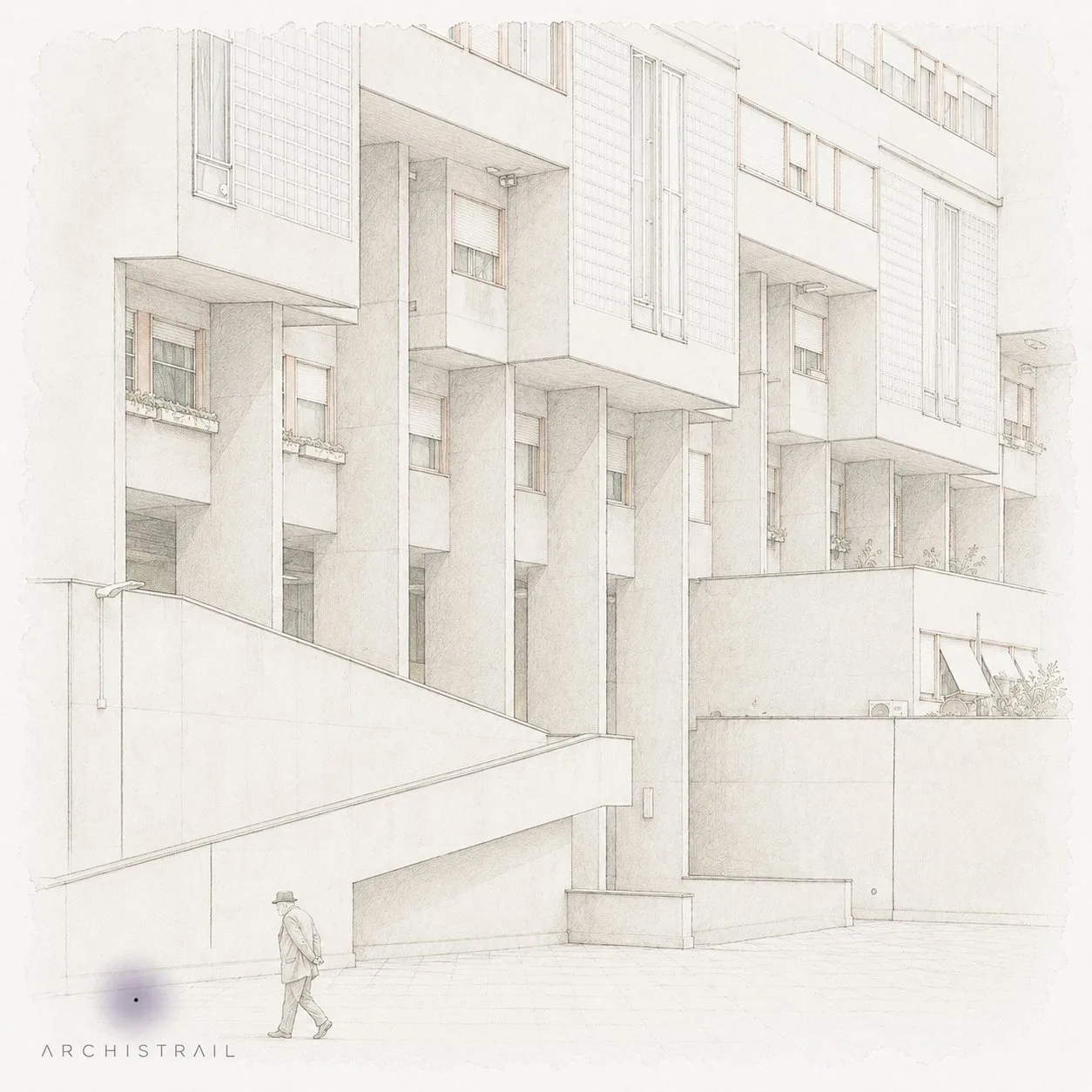
FIG. 01
ArchitectAldo Rossi, Carlo Aymonino
Year1972
LocationMilan, Italy
Coordinates45.4983° N, 9.1007° E
TypeArchitecture · Housing
StatusWorth Visiting
Sign in to save and check in to this place.
About this place
Aldo Rossi's most famous built work — a stark, arcaded red housing block in the Gallaratese district that became a touchstone of Italian Neo-Rationalism.
The Monte Amiata housing complex in Milan's Gallaratese district is one of the defining works of postwar Italian architecture, and the building most closely associated with Aldo Rossi's theoretical writings on the city and typology. Built between the late 1960s and 1972 as part of a larger public housing masterplan led by Carlo Aymonino, the complex comprises several blocks; Rossi's own contribution — a long, four-storey slab raised on a colonnade of closely spaced square piers — is the section most visited and photographed today, sometimes nicknamed the 'Red Dinosaur' for its severe, repetitive silhouette.
Rossi's block strips housing architecture down to near-abstraction: a continuous ground-floor arcade of unadorned concrete piers supports plain brick-red upper floors punctuated by identical square windows, with none of the balconies, color variation, or picturesque incident typical of contemporary housing elsewhere in Europe. The effect is deliberately monumental and almost archaic — Rossi described his ambition as designing a building that felt as if it had always existed, independent of any particular architectural fashion. Aymonino's adjoining blocks, by contrast, are more varied in massing and color, creating a dialogue between two very different sensibilities within a single complex.
The Gallaratese district itself is a largely residential, workaday part of northwest Milan, some way from the tourist center — visiting the complex means confronting Rossi's architecture in its intended everyday context, still inhabited and unrestored, rather than as a museum piece. For students of architecture, particularly Rationalism and typological theory, it remains close to a pilgrimage site.
Architecture · Housing
Nearby places
More in MilanAll →
Comments
Sign in to leave a comment.
Access conditions may change. Please check current opening and access information with the venue before visiting.
Something wrong or missing?