Must Visit
San Cataldo Cemetery
Aldo Rossi, Gianni Braghieri · 1971
ArchitectAldo Rossi, Gianni Braghieri
Year1971
LocationModena, Italy
Coordinates44.6592° N, 10.9094° E
TypeLandscape · Cemetery Landscape, Architecture · Contemporary Architecture
StatusMust Visit
Sign in to save and check in to this place.
About this place
Aldo Rossi's landmark extension to Modena's cemetery — a cube-windowed ossuary and a stark conical chimney that made death itself into architectural theory.
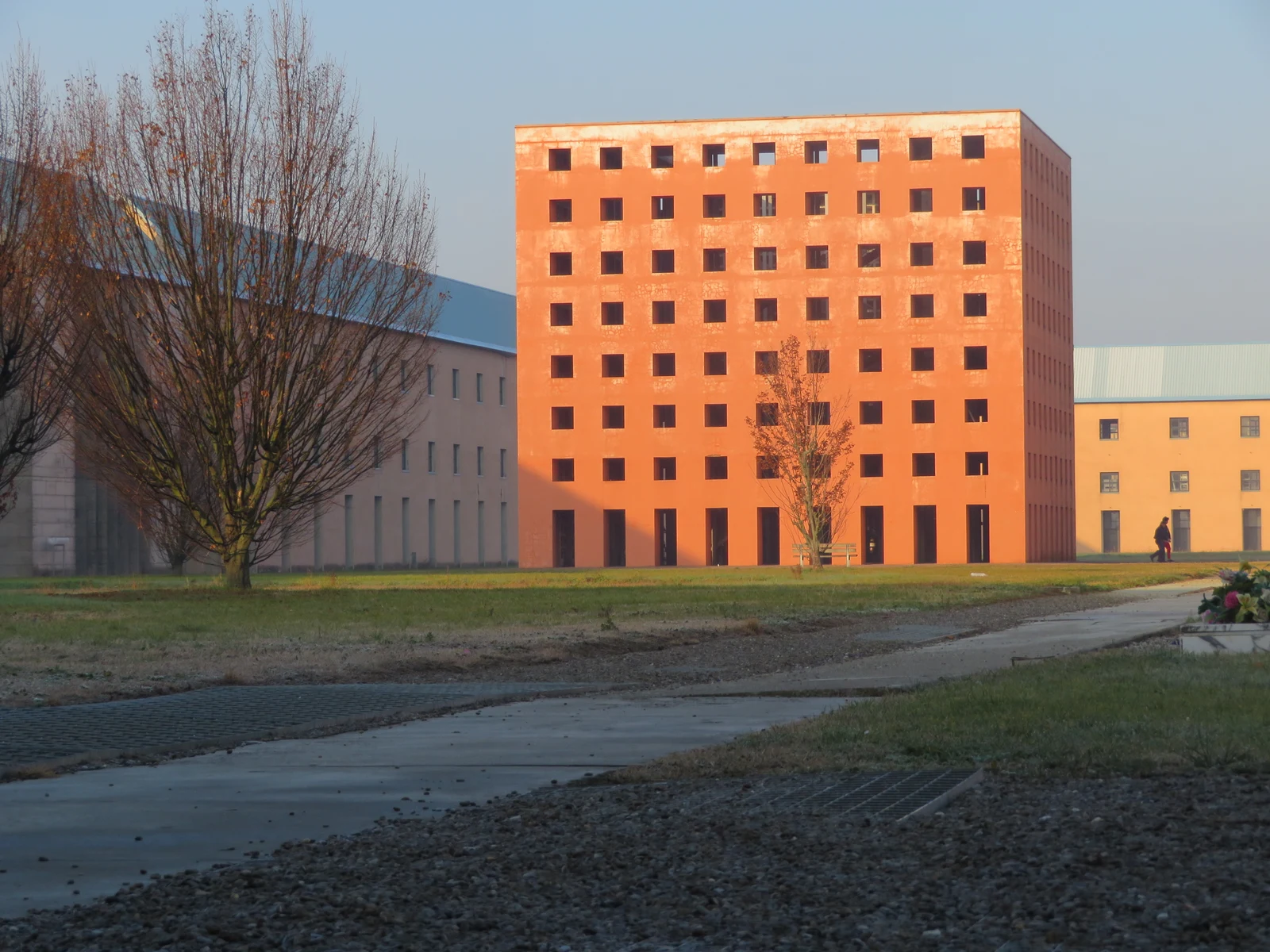
Won in a 1971 competition and built in stages from the mid-1970s onward, Aldo Rossi's extension to the Cemetery of San Cataldo is among the defining works of Italian Neo-Rationalism and one of the most written-about cemeteries of the 20th century. Rossi, working with Gianni Braghieri, conceived the project less as landscaping than as a small, silent city for the dead — a sequence of stark, geometric forms bound together by his recurring architectural vocabulary of cubes, cones, and colonnades.
The most photographed element is the great cube ossuary — a hollow, roofless volume punctured by rows of square windows, its emptiness deliberately unsettling, evoking both a ruin and a house stripped of everything but structure. Nearby, a tall conical chimney-like form (long read as a reference to a crematorium, though never used as one) anchors the composition, while long colonnaded galleries house columbaria in orderly, repetitive bays. The palette throughout is reduced to bare concrete, brick, and stucco, avoiding any ornamental softening of the subject matter.
Rossi described the cemetery as 'the house of the dead' and drew explicitly on the analogy between a house and a tomb, and between a city and a cemetery — ideas central to his book The Architecture of the City. Decades after the competition win, the complex remains unfinished, itself a kind of ruin from the start, which only deepens its melancholic, timeless quality. It rewards a visit for anyone interested in Rossi's theoretical writing, Italian postmodernism, or cemetery architecture as a genre in its own right.
Landscape · Cemetery LandscapeArchitecture · Contemporary Architecture
More in ModenaAll →
Comments
Sign in to leave a comment.
Access conditions may change. Please check current opening and access information with the venue before visiting.
Something wrong or missing?