Worth Visiting
Villa Mairea
Alvar Aalto, Aino Aalto · 1939
ArchitectAlvar Aalto, Aino Aalto
Year1939
LocationNoormarkku, Finland
Coordinates61.5975° N, 21.8746° E
TypeArchitecture · Modernism
StatusWorth Visiting
Sign in to save and check in to this place.
About this place
Alvar and Aino Aalto's 1939 country house for the Gullichsen family in Noormarkku — one of the defining works of organic Modernism, now a museum open to visitors.
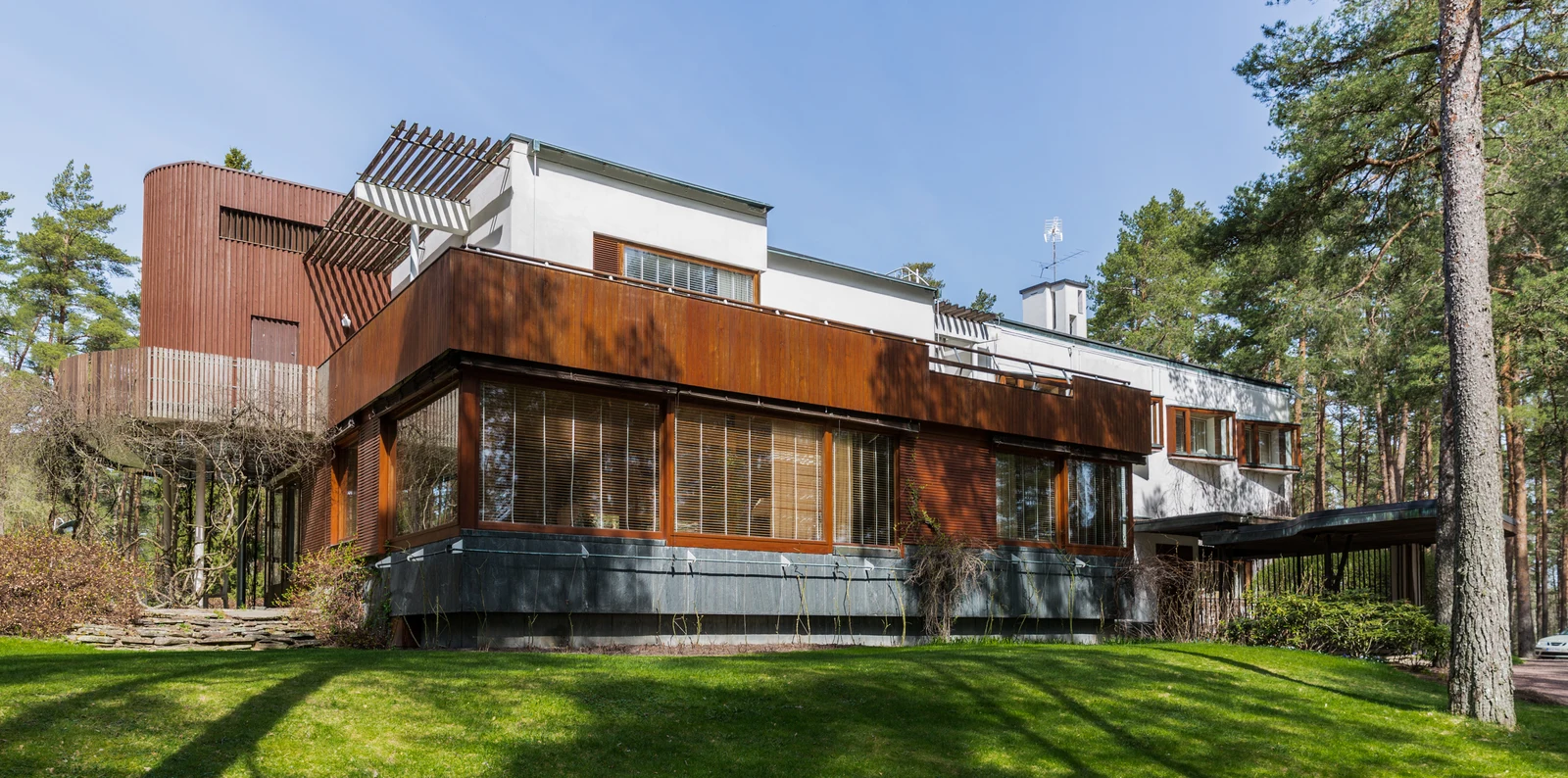
Villa Mairea, designed by Alvar and Aino Aalto in 1938–1939 for industrialist Harry Gullichsen and his wife Maire, is one of the most thoroughly considered private residences of the 20th century — a house in which the competing claims of Finnish vernacular tradition, Japanese spatial sensibility, and European Modernism are held in productive tension rather than resolved into any single style.
The Gullichsens asked for a house that could function as a working model for what modern Finnish housing might become — generous enough in programme to test ideas at full scale. The result is a country house that reads differently from every angle: the main living space is open and column-free in a way that echoes Mies, but the columns at the entrance are wrapped in rattan in a way that echoes vernacular Finnish craft. The sauna, pool, and garden pavilion are set into the surrounding forest rather than cleared away from it.
The plan organises the main volumes around a double-height living space that opens through sliding glass walls to the garden. The staircase — one of the most photographed elements of the house — is an irregular column of stacked timber poles, evoking a forest clearing. The studio wing, cantilevered and clad in timber, gives Maire's studio a north-facing skylight and a direct connection to the garden.
Villa Mairea was opened as a museum in 1997 and is managed by the Maire Gullichsen Art Foundation. Guided tours are available by appointment. The house remains in the ownership of the Gullichsen family and is still used as a family retreat, which means its condition is unusually good for a building of this age and ambition.
Architecture · Modernism
Nearby places
More in NoormarkkuAll →
No other places in Noormarkku yet.
Comments
Sign in to leave a comment.
Access conditions may change. Please check current opening and access information with the venue before visiting.
Something wrong or missing?