Must Visit
Wolfson Building for Mechanical Engineering
Louis Kahn · 1980
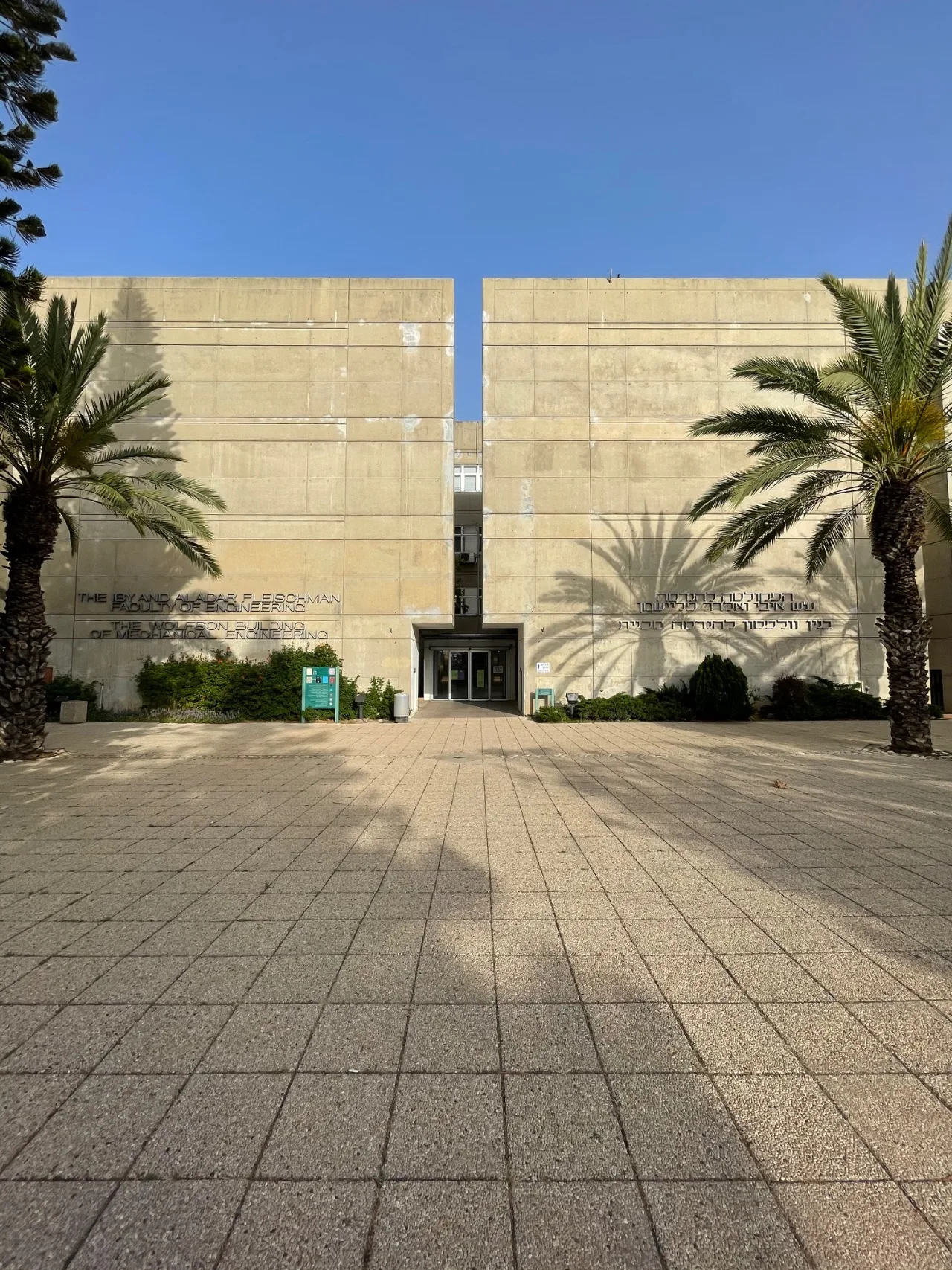
FIG. 01
ArchitectLouis Kahn
Year1980
LocationTel Aviv-Yafo, Israel
Coordinates32.1102° N, 34.8057° E
TypeArchitecture · Brutalism
StatusMust Visit
Sign in to save and check in to this place.
About this place
Louis Kahn's only completed building in Israel — a brutalist concrete structure at Tel Aviv University, finished posthumously in 1980, six years after his death.
The Wolfson Building for Mechanical Engineering at Tel Aviv University is Louis Kahn's sole realized work in Israel — and one of the few buildings completed posthumously from his designs. Kahn died in 1974; the building was finished in 1980, six years later, by the architectural team carrying forward his final intentions.
The building is fundamentally Kahnian in its structural logic: a massive concrete presence anchored by its own weight rather than by ornament. The exterior presents largely windowless walls — surfaces of raw, board-formed concrete punctuated only by narrow vertical slits at the main entrance. This introversion is deliberate: the program organizes itself around a five-level interior courtyard that functions as an open-air amphitheater, drawing light downward from above rather than outward from the perimeter. Offices, classrooms, and laboratories ring this central void on each level, oriented inward toward the shared communal space.
The circular ventilation ducts — described informally as "nostrils" — distributed throughout the building are among its most distinctive elements, serving both functionally and sculpturally. They mark the building as belonging to Kahn's later vocabulary of "served" and "servant" spaces, where the mechanical systems are given honest formal expression rather than concealed within the structure.
Over the decades since completion, original features — including the wooden doors and some of the open corridor detailing — have been modified, a recurring tension between maintenance pragmatism and the integrity of the original architectural vision. The building nevertheless remains a pilgrimage site for architects and students of Kahn's work, and its influence on subsequent Israeli architecture is broadly acknowledged.
Architecture · Brutalism
More in Tel Aviv-YafoAll →
Comments
Sign in to leave a comment.
Access conditions may change. Please check current opening and access information with the venue before visiting.
Something wrong or missing?