Worth Visiting
2 Willow Road
Ernő Goldfinger · 1939
ArchitectErnő Goldfinger
Year1939
LocationLondon, United Kingdom
Coordinates51.5572° N, 0.1692° W
TypeArchitecture · Modernism, Culture · Museum
StatusWorth Visiting
Sign in to save and check in to this place.
About this place
Ernő Goldfinger's own family home in Hampstead — a rare, fully intact Modernist house-as-manifesto, now preserved by the National Trust exactly as the architect left it.
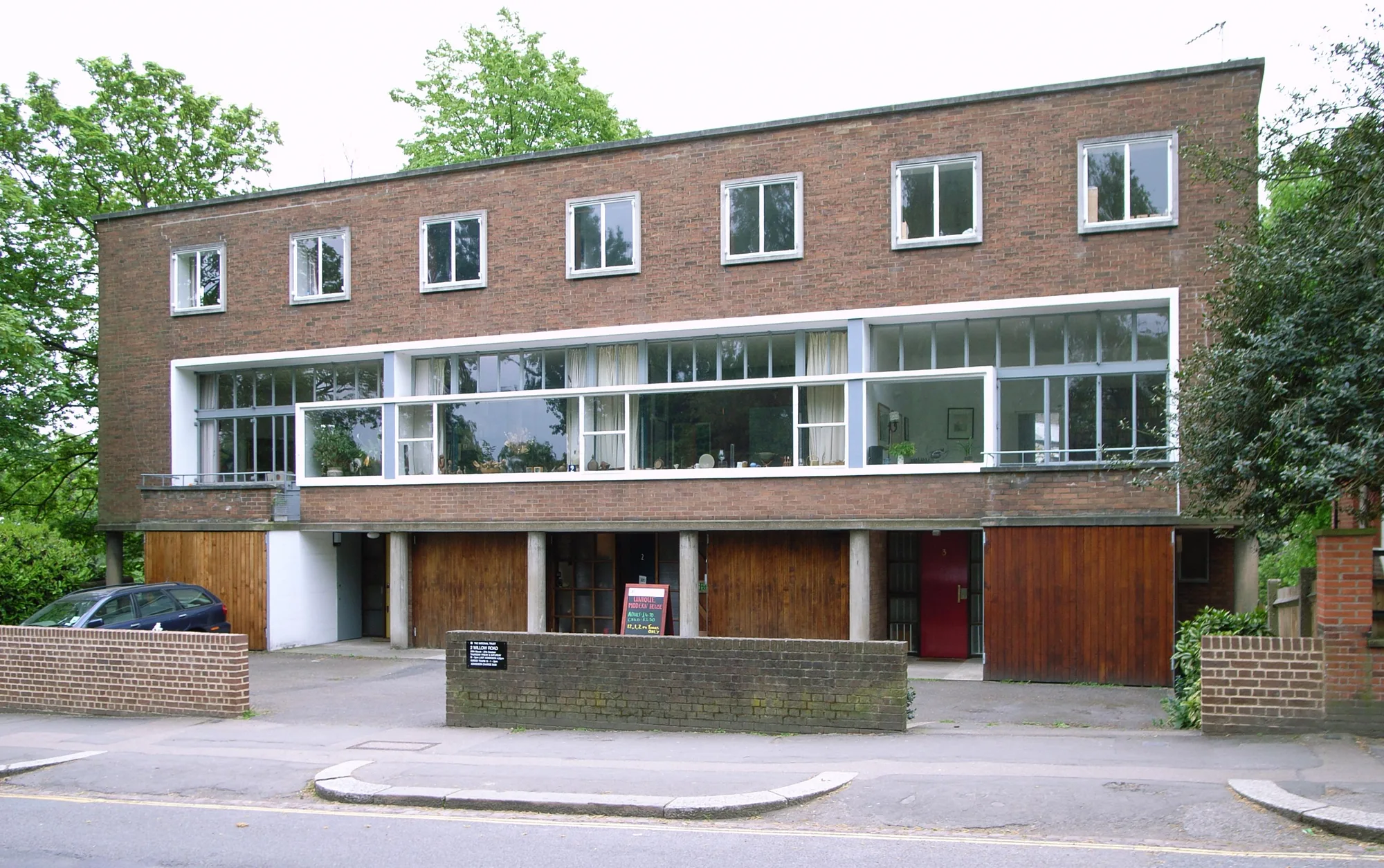
Completed in 1939, 2 Willow Road was designed by Hungarian-born architect Ernő Goldfinger as one of three linked terrace houses, with the largest and central unit reserved for his own family. Built on the edge of Hampstead Heath at a time when Modernism was still viewed with deep suspicion by much of the British architectural establishment — the project drew a public campaign of local opposition, including from Ian Fleming, whose eventual choice of the villain's name 'Goldfinger' in his James Bond novels is widely believed to be a swipe at the architect — the house was Goldfinger's own demonstration of what reinforced concrete-frame construction and open planning could offer even within a conventional London streetscape.
Behind a restrained brick and concrete facade that deliberately respects the scale and rhythm of its Victorian neighbours, the interior is a fully realized piece of Modernist design: a flexible, sliding-partition living space that could open into one great room or be divided for different uses, a dramatic helical concrete staircase as the house's sculptural centrepiece, and built-in furniture designed by Goldfinger himself alongside pieces by contemporaries including Marcel Breuer, Henry Moore, and Bridget Riley collected over the decades the family lived there.
Acquired by the National Trust in 1993 after Goldfinger's widow's death, the house is preserved essentially as the family left it — furniture, art, and fittings intact — making it one of the very few Modernist houses anywhere that can be experienced as a lived-in, complete work rather than an emptied museum shell. For anyone interested in the domestic side of the Modern Movement in Britain, it's an essential, almost time-capsule visit.
Architecture · ModernismCulture · Museum

More in LondonAll →
Comments
Sign in to leave a comment.
Access conditions may change. Please check current opening and access information with the venue before visiting.
Something wrong or missing?