Must Visit
Bangju Church
Itami Jun · 2009
ArchitectItami Jun
Year2009
LocationSeogwipo, South Korea
Coordinates33.3051° N, 126.3873° E
TypeArchitecture · Religious Building, Landscape · Courtyard Garden
StatusMust Visit
Sign in to save and check in to this place.
About this place
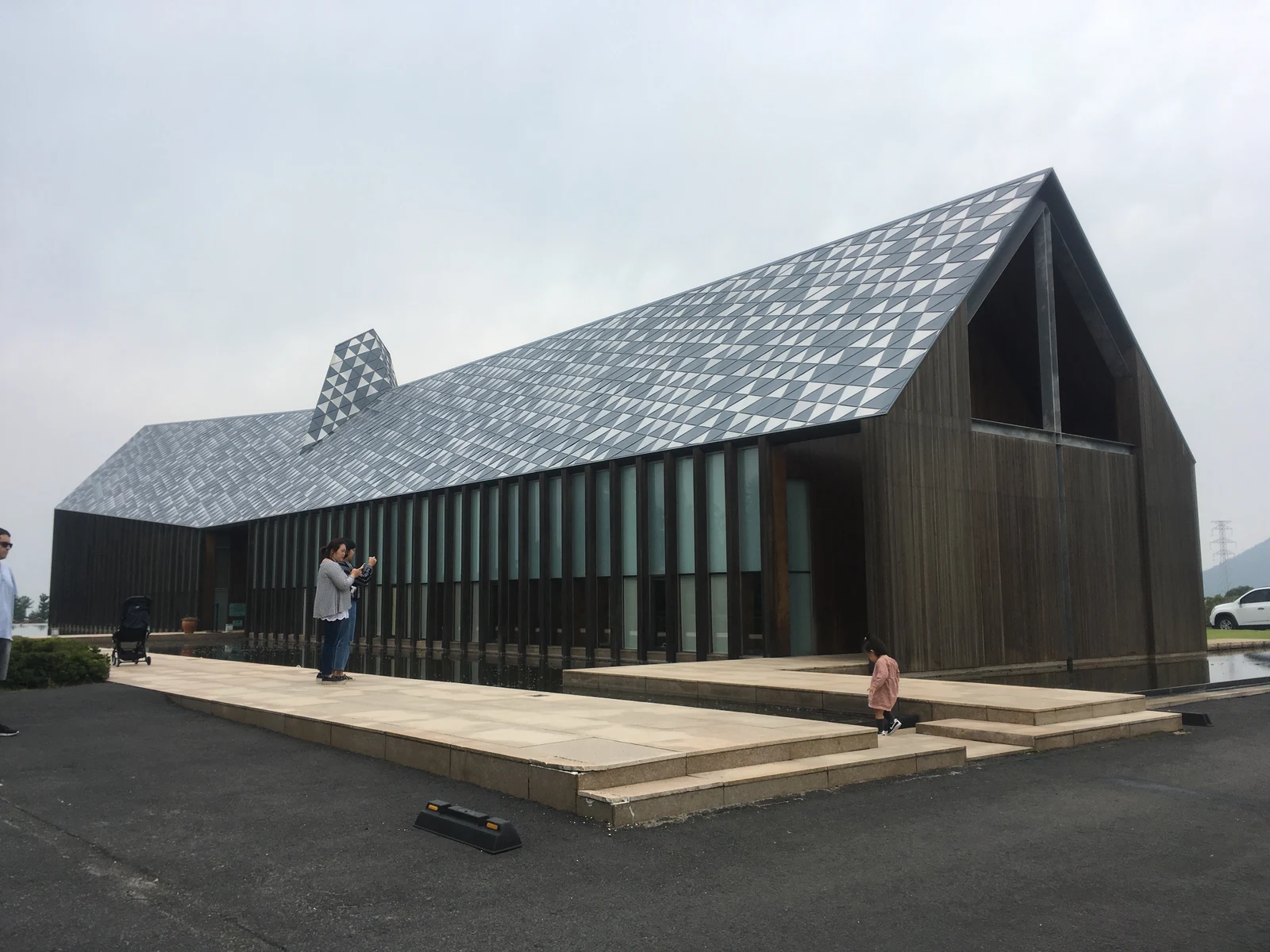
Ark-shaped church by Itami Jun that appears to float on a reflective pond. The zinc diamond-tile hull and dark timber facade make this one of Jeju's most striking contemporary buildings.
Bangju Church stands on a clearing on the southern slopes of Jeju Island, its zinc-clad hull rising above a still, reflective pond that makes the building appear to float — an echo of Noah's Ark at rest on the water. Completed in 2009 and designed by Korean-Japanese architect Itami Jun (Yutaka Maeda), the church won the Korean Institute of Architects Architecture Grand Prize in 2010, just two years before Itami Jun's death in 2011.
The building's form is long and boat-like, enclosed by dark weathered timber panels at the ends and a continuous glass and timber screen along the flanks. The roof is covered entirely in zinc tiles arranged in a diamond pattern — angled facets that deflect and scatter light. A small cross is the sole religious marker on an otherwise abstract exterior. The restraint is deliberate: the building refuses gesture, relying instead on proportion and material precision.
The reflective pond is not incidental. It is structural to the composition. At certain times of day the entire building appears suspended above its own mirror image, dissolving the boundary between structure and sky. The surrounding landscape — flat lawn, low planting, a distant volcanic ridgeline — completes the picture. Visitors often arrive at dawn when the reflection is cleanest.
Inside, the spatial quality is defined by light. The zinc roof geometry channels daylight through interior apertures in ways that shift perceptibly as the day moves. The nave is simple — timber, stone, diffused glass — and its atmosphere registers as genuinely contemplative rather than theatrical.
Itami Jun spent his career navigating two cultural identities — born in Tokyo to Korean parents, working in both countries — and his architecture consistently sought elemental forces: earth, water, wind, light. Bangju Church is perhaps the most resolved expression of this instinct: a building that uses water as its primary architectural material, even as the structure itself is straightforward in its construction.
There are no guided tours; the church is an active place of worship. Visitors may enter during opening hours (typically 06:00–13:00). The exterior composition, viewed from the approach path across the pond, is the primary architectural experience.
Architecture · Religious BuildingLandscape · Courtyard Garden
More in SeogwipoAll →
Comments
Sign in to leave a comment.
Access conditions may change. Please check current opening and access information with the venue before visiting.
Something wrong or missing?