Worth Visiting
Caplutta Sogn Benedetg
Peter Zumthor · 1988
ArchitectPeter Zumthor
Year1988
LocationSumvitg, Switzerland
Coordinates46.7349° N, 8.9390° E
TypeArchitecture · Religious Building
StatusWorth Visiting
Sign in to save and check in to this place.
About this place
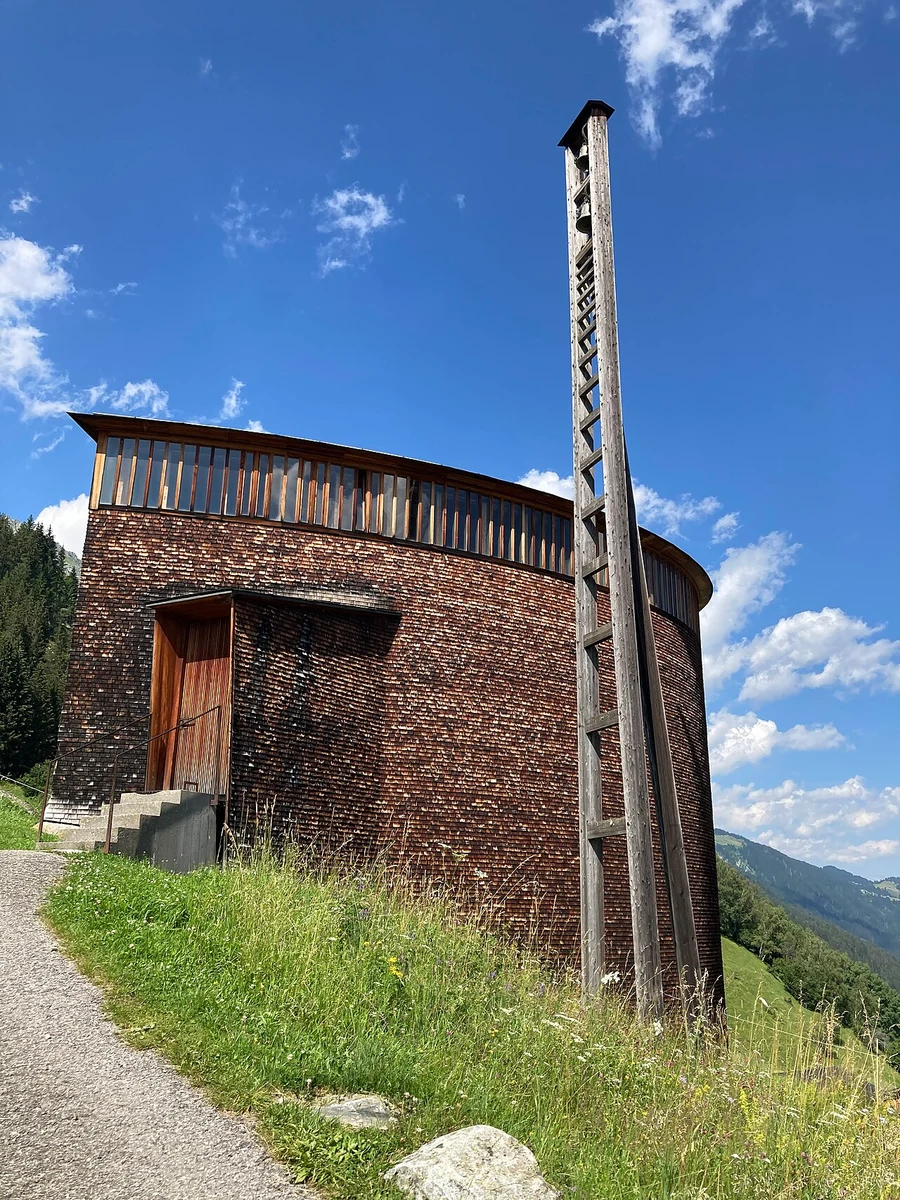
Oval timber chapel by Peter Zumthor (1988), built after an avalanche destroyed its predecessor. Celebrated for its shingle skin, radial wooden frame, and luminous alpine atmosphere.
Caplutta Sogn Benedetg stands on a hillside meadow above the hamlet of Sumvitg in the Graubunden Alps, replacing a Baroque chapel swept away by avalanche in 1984. Peter Zumthor won the commission through competition and completed the building in 1988, in collaboration with engineers Jurg Buchli and Jurg Conzett.
The plan is a narrow ellipse - less a conventional nave than a cupped hand. A radial framework of vertical wooden ribs forms both structure and interior surface, their rhythmic repetition creating a sense of enclosure that feels simultaneously compressed and infinite. Locally-sourced wooden shingles tile the exterior, darkening over the seasons into the pewter and silver tones of the surrounding landscape.
Inside, the curved walls draw the eye upward to a series of clerestory windows set just below the roof. Light enters in narrow bands that shift throughout the day, moving across the pale timber with an almost liquid quality. The smell of wood and the texture of grain are inseparable from the spatial experience - Zumthor's conviction that architecture communicates through material before it communicates through form.
The entrance is deliberately compressed: you pass through a low porch before the interior opens upward. Curved pews follow the walls. A freestanding wooden campanile marks the approach from below, its open frame a counterpoint to the sealed oval of the chapel body.
The building earned the Neues Bauen in den Alpen award in 1992 and the Auszeichnungen fur gute Bauten Graubunden in 1994. It remains one of Zumthor's most studied works: a proof that presence in architecture is achieved not through formal complexity but through material honesty and spatial restraint.
Architecture · Religious Building
More in SumvitgAll →
Comments
Sign in to leave a comment.
Access conditions may change. Please check current opening and access information with the venue before visiting.
Something wrong or missing?