Must Visit
Casa da Música
OMA / Rem Koolhaas · 2005
ArchitectOMA / Rem Koolhaas
Year2005
LocationPorto, Portugal
Coordinates41.1588° N, 8.6307° W
TypeArchitecture · Contemporary Architecture, Culture · Performance Space
StatusMust Visit
Sign in to save and check in to this place.
About this place
Rem Koolhaas's polyhedron concert hall anchoring the Rotunda da Boavista in Porto. Opened 2005, one of the defining cultural buildings of the 2000s.
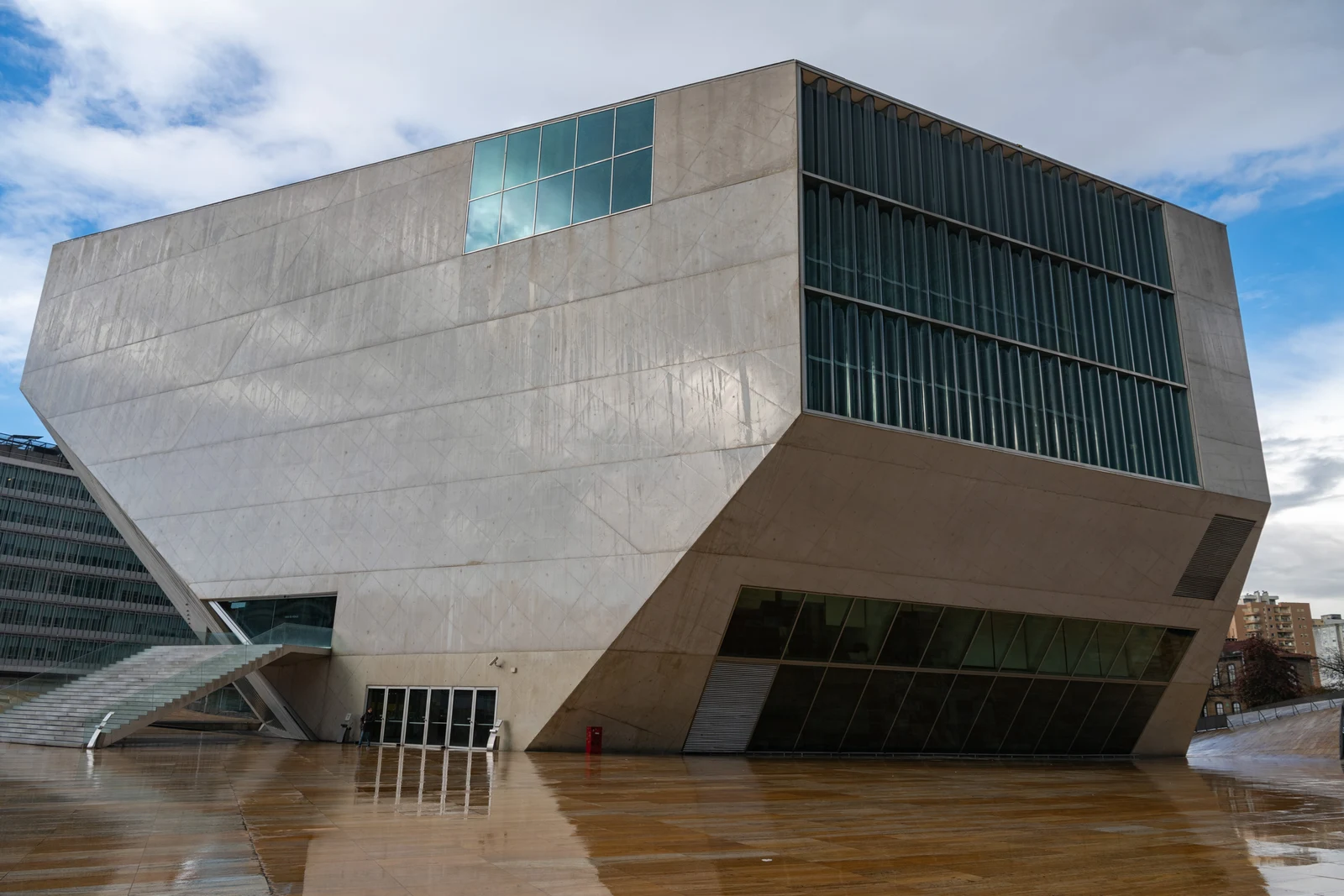
Casa da Música sits at the centre of the Rotunda da Boavista like a displaced geological formation — a white concrete polyhedron with no obvious front or back, its angled planes catching light differently at every hour. OMA won the commission in 1999, and the building that opened in 2005 remains one of Rem Koolhaas's most resolved works: a concept that could have been merely provocative instead became genuinely functional and spatially rich.
The origin story matters. The design began as a house for a private client — a single domestic space threaded through a structural shell — and the concert hall traces that logic: the main auditorium is essentially a room inserted into the building, its two ends glazed with corrugated glass that looks out over the city. From inside, Porto is always present, framed through the undulating glass at the far end of the stage, a view that is disorienting and memorable in equal measure.
The building's exterior geometry means every approach reads differently. The plaza around it, paved in the traditional Portuguese calçada pattern, keeps the building floating rather than grounded. At night, the glazed faces glow and the concrete planes recede into darkness, reversing the daytime reading entirely.
Inside, the section is a tour de force: multiple auditoria, rehearsal rooms, a rooftop terrace and bar are stacked and interlocked, connected by stairways clad in gold-leaf tile and azulejo panels by Parede. Guided tours of the spaces not open during performances are worth taking — the VIP rooms in particular, each one a different material exercise, reveal how seriously the project treats its secondary spaces.
Architecture · Contemporary ArchitectureCulture · Performance Space
More in PortoAll →
Comments
Sign in to leave a comment.
Access conditions may change. Please check current opening and access information with the venue before visiting.
Something wrong or missing?