Visit if Near
Chapel of Reconciliation
Peter Sassenroth & Rudolf Reitermann · 2000
ArchitectPeter Sassenroth & Rudolf Reitermann
Year2000
LocationBerlin, Germany
Coordinates52.5358° N, 13.3919° E
TypeArchitecture · Religious Building, Public Space · Memorial
StatusVisit if Near
Sign in to save and check in to this place.
About this place
A rammed-earth chapel built in 2000 on the former Berlin Wall death strip, on the site of a 19th-century church demolished by the GDR in 1985. One of the most charged architectural sites in Berlin.
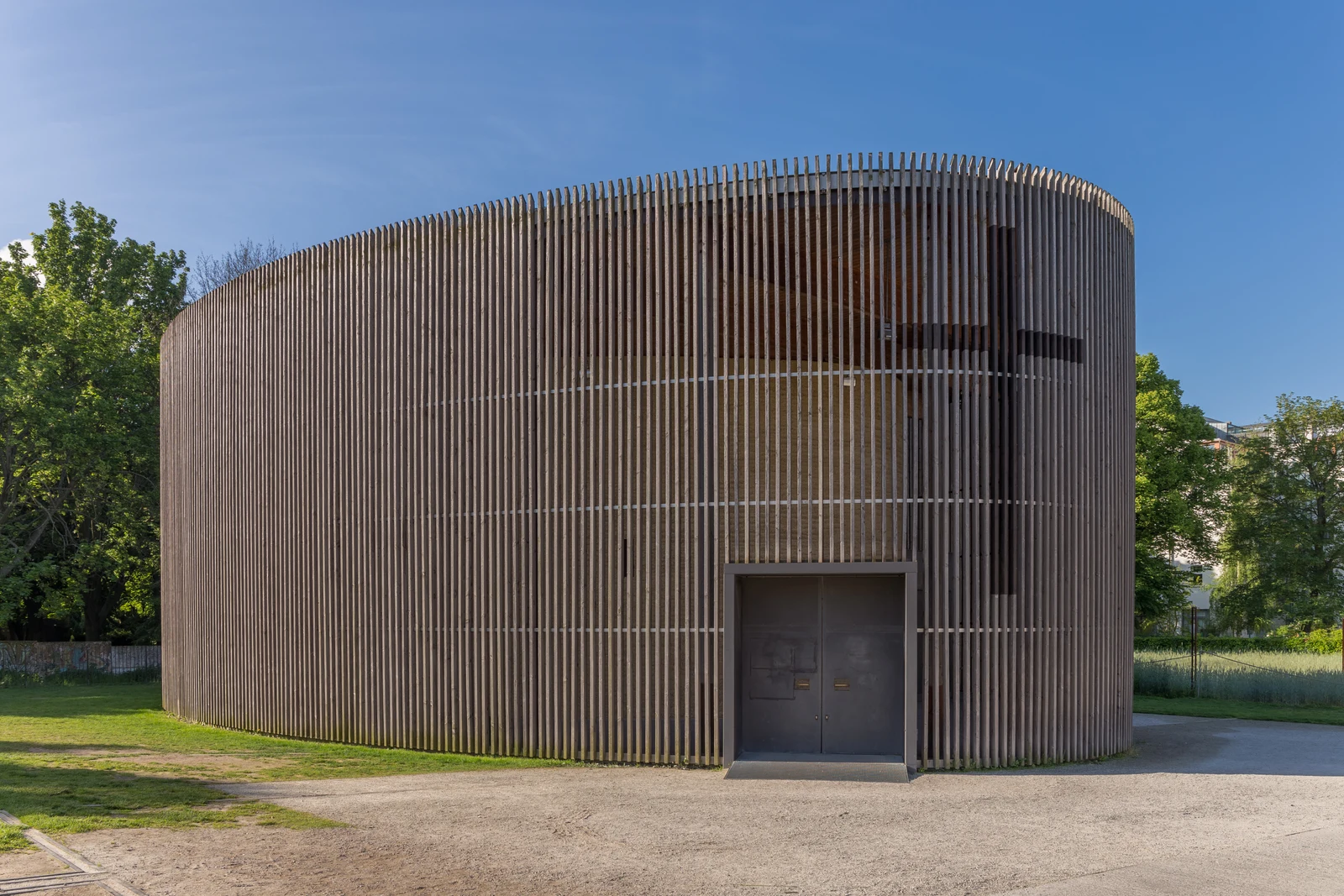
The Chapel of Reconciliation stands on Bernauer Straße at the heart of the Berlin Wall Memorial, on ground that carries an exceptional weight of recent history. A Protestant church — the Versöhnungskirche, built in 1894 — stood on this site until 1985, when it was demolished by the GDR because it obstructed surveillance of the death strip. After reunification, the congregation commissioned Peter Sassenroth and Rudolf Reitermann to build a new chapel in its place.
The architects chose rammed earth as their primary material, mixed with the rubble of the demolished church — a decision that is quietly but powerfully symbolic. The building reads as a solid oval mass from outside, its louvred timber screen giving a warm, textured surface that contrasts with the raw concrete and steel of the wall documentation nearby. Inside, the oval plan focuses attention toward a simple altar and a wooden cross salvaged from the original church, and the rammed-earth walls — visibly stratified, earthy in colour — enclose the space with an unusual warmth and materiality.
The relationship between the chapel and its context is central to the experience. It sits within the memorial strip where the death strip once ran, surrounded by preserved wall sections, ghost outlines of demolished buildings, and photographs documenting the border's history. The chapel functions as a place of daily prayer and as a memorial to those who died attempting to cross.
The building is small and the interior austere, but the site carries an intensity that architecture rarely has to absorb. Worth visiting alongside the Berlin Wall Memorial documentation centre immediately adjacent.
Architecture · Religious BuildingPublic Space · Memorial
Nearby places
More in BerlinAll →
Comments
Sign in to leave a comment.
Access conditions may change. Please check current opening and access information with the venue before visiting.
Something wrong or missing?