Visit if Near
Topography of Terror
Ursula Wilms / Heinle, Wischer und Partner · 2010
ArchitectUrsula Wilms / Heinle, Wischer und Partner
Year2010
LocationBerlin, Germany
Coordinates52.5067° N, 13.3835° E
TypeCulture · Museum, Public Space · Memorial, Architecture · Civic Building
StatusVisit if Near
Sign in to save and check in to this place.
About this place
Open-air memorial and documentation centre built on the site of the SS and Gestapo headquarters, with a preserved stretch of the Berlin Wall running along its perimeter.
The Topography of Terror occupies one of Berlin's most loaded sites: the former headquarters of the SS, Gestapo, and Reich Security Main Office — the administrative core of Nazi terror from 1933 to 1945. After reunification, the rubble-strewn lot became a provisional open-air exhibition before a permanent solution was finally agreed upon.
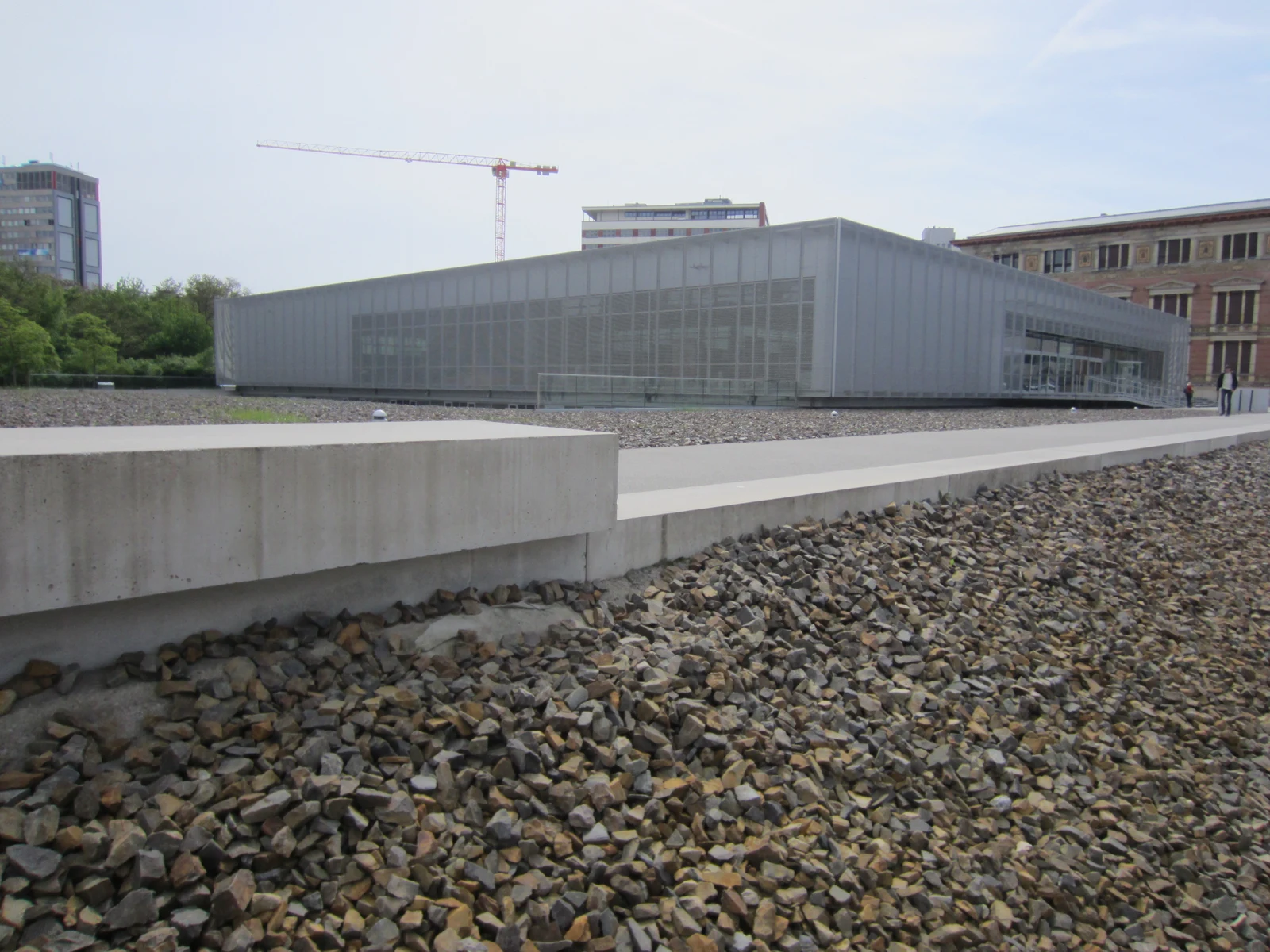
The indoor documentation centre, designed by Ursula Wilms of Heinle, Wischer und Partner with landscape architect Heinz W. Hallmann, opened in 2010. The building is deliberately understated — a long, low glass and steel pavilion that lies flat against the ground rather than asserting itself. Inside, dense permanent exhibitions trace the structure of the SS and Gestapo, how terror was organised bureaucratically, and who carried it out.
Outside, the topography itself is the main exhibit. A 200-metre stretch of the Berlin Wall survives along Niederkirchnerstraße — one of the longest remaining sections in the city. Exposed foundations of the original Gestapo prison cells are visible in the gravel field, mapped and interpreted with steel markers. The combination of raw site, archaeological remnant, and quiet pavilion creates a space of unusual gravity.
The museum is free to enter and open year-round — an intentional decision, treating the site as public space rather than attraction. The tension between the bureaucratic plainness of the building and the weight of what happened here is difficult to shake.
Culture · MuseumPublic Space · MemorialArchitecture · Civic Building
Nearby places
More in BerlinAll →
Comments
Sign in to leave a comment.
Access conditions may change. Please check current opening and access information with the venue before visiting.
Something wrong or missing?