Must Visit
Memorial to the Murdered Jews of Europe
Peter Eisenman · 2005
ArchitectPeter Eisenman
Year2005
LocationBerlin, Germany
Coordinates52.5138° N, 13.3784° E
TypePublic Space · Memorial, Installation · Permanent Installation
StatusMust Visit
Sign in to save and check in to this place.
About this place
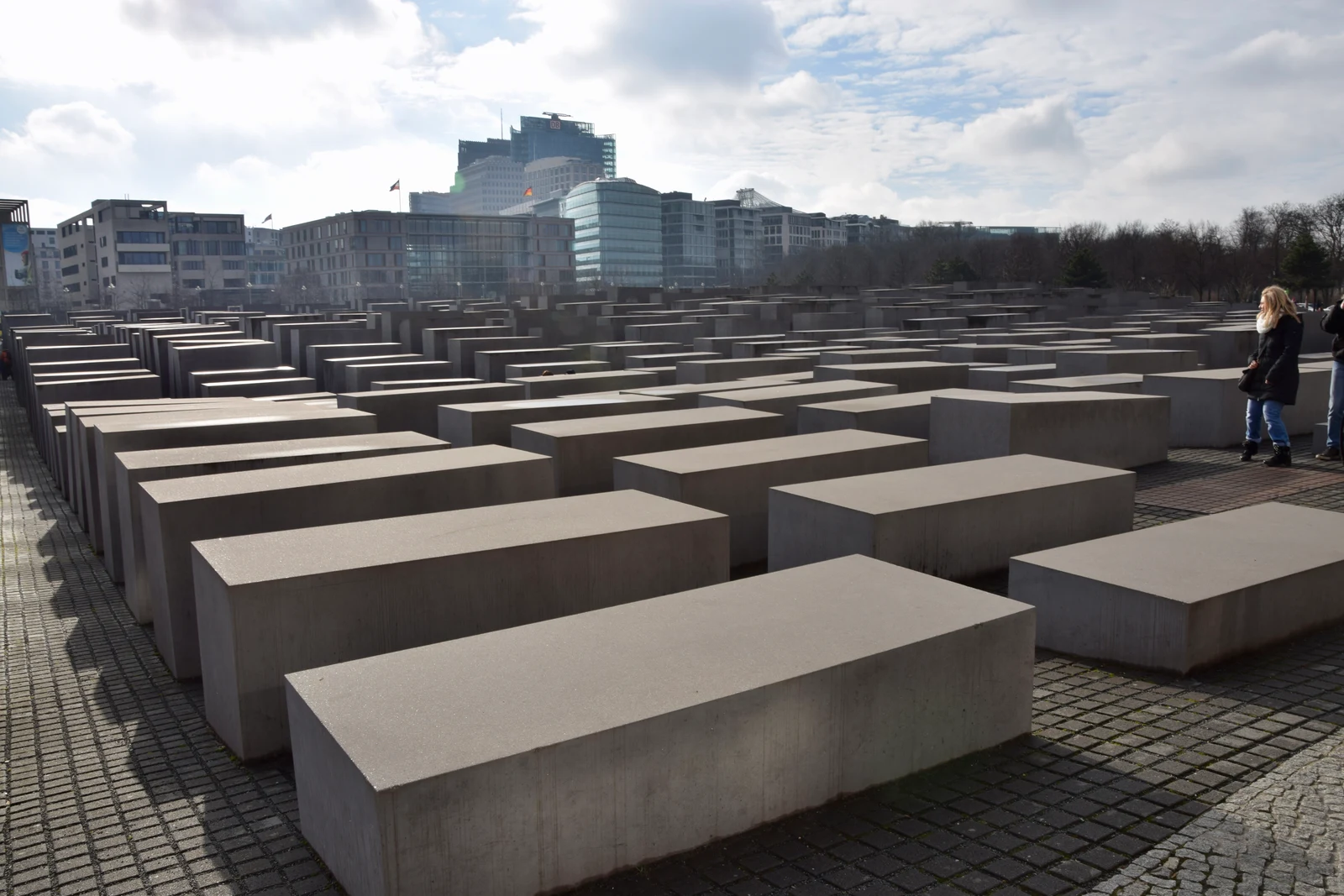
Peter Eisenman's field of 2,711 concrete stelae near the Brandenburg Gate, opened 2005. One of the most spatially powerful memorials built anywhere in the 20th century.
The Memorial to the Murdered Jews of Europe occupies a 19,000-square-metre site one block south of the Brandenburg Gate, in the centre of Berlin. Peter Eisenman's design — selected after a decade-long controversy and revised repeatedly before construction began in 2003 — consists of 2,711 grey concrete stelae arranged in a grid across undulating ground. It opened in May 2005, sixty years after the end of the Second World War.
The stelae vary in height from near-flush with the ground at the field's edges to over four metres at its centre, where the topography dips and the blocks tower above visitors walking between them. This simple topographic device transforms the experience entirely: what reads from outside as a legible grid dissolves on entry into a disorienting labyrinth of narrow corridors, shifting light and compressed space. The geometry is absolute but the experience is anything but — the field produces isolation, unease, and an odd kind of silence even within a busy city.
Eisenman has resisted fixed symbolic readings of the work, describing it as an open field of signification rather than a narrative memorial. The absence of names, of images, of explicit reference forces visitors to construct their own relationship to the space and what it represents. An underground information centre beneath the field provides historical documentation.
The memorial is controversial architecturally — the repetition, the refusal of conventional memorial language, the scale — but few spaces in Berlin match its psychological weight. It should be walked through slowly, not photographed from the edge. The changing light conditions across the day, and the contrast between the field's interior and the city visible above the stelae, are central to the experience.
Public Space · MemorialInstallation · Permanent Installation
Nearby places
More in BerlinAll →
Comments
Sign in to leave a comment.
Access conditions may change. Please check current opening and access information with the venue before visiting.
Something wrong or missing?