Worth Visiting
Corbusierhaus
Le Corbusier · 1957
ArchitectLe Corbusier
Year1957
LocationBerlin, Germany
Coordinates52.5103° N, 13.2437° E
TypeArchitecture · Housing
StatusWorth Visiting
Sign in to save and check in to this place.
About this place
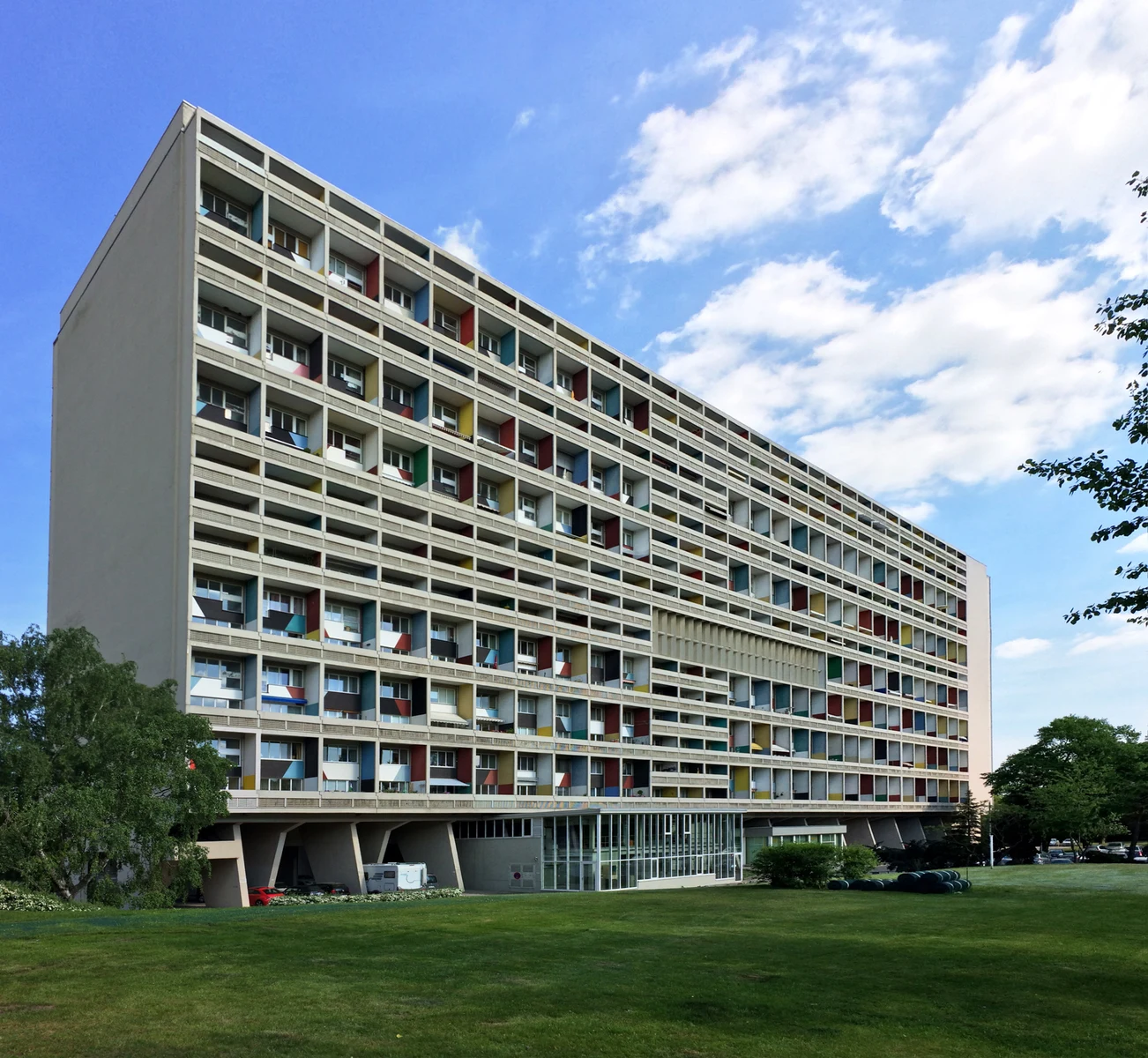
Le Corbusier's Unité d'Habitation built for the 1957 Interbau exhibition in Berlin-Westend — the largest of his Unité buildings, now a listed monument.
The Corbusierhaus is Le Corbusier's contribution to the 1957 Interbau International Building Exhibition in West Berlin, and the most extreme realisation of his Unité d'Habitation typology. At 17 storeys and 530 apartments, it is the largest of the five Unités built to his design, originally intended for a denser urban site and transplanted here to a suburban fringe near the Olympiastadion that never suited it in quite the way Corbusier envisioned.
The building follows the Unité programme closely: apartments run the full depth of the slab, alternating between two interlocking section types that allow an internal corridor to serve units on two floors. The pilotis raise the entire mass off the ground, leaving the landscape continuous beneath. The roof carries communal facilities — originally including a running track, a paddling pool, and a gymnasium — and the building's internal street was conceived as a vertical village with shops and services.
The brise-soleil on the long facades, cast in rough concrete and coloured in primary hues on the recessed balcony backs, gives the building its characteristic visual texture — a pixelated surface that reads differently from every angle and distance. The scale is deliberately urban in a suburban setting, which created ongoing tension with its context and with residents accustomed to different densities.
Now a listed monument and largely residential, the Corbusierhaus sits alongside the Niemeyer building in the Hansaviertel as evidence of the 1957 exhibition's ambition to reinvent European housing through the lens of international modernism. Worth visiting as a complement to the rest of the Interbau ensemble.
Architecture · Housing
Nearby places
More in BerlinAll →
Comments
Sign in to leave a comment.
Access conditions may change. Please check current opening and access information with the venue before visiting.
Something wrong or missing?