Visit if Near
Bauhaus-Archiv
Walter Gropius · 1979
ArchitectWalter Gropius
Year1979
LocationBerlin, Germany
Coordinates52.5069° N, 13.3517° E
TypeCulture · Museum, Architecture · Modernism
StatusVisit if Near
Sign in to save and check in to this place.
About this place
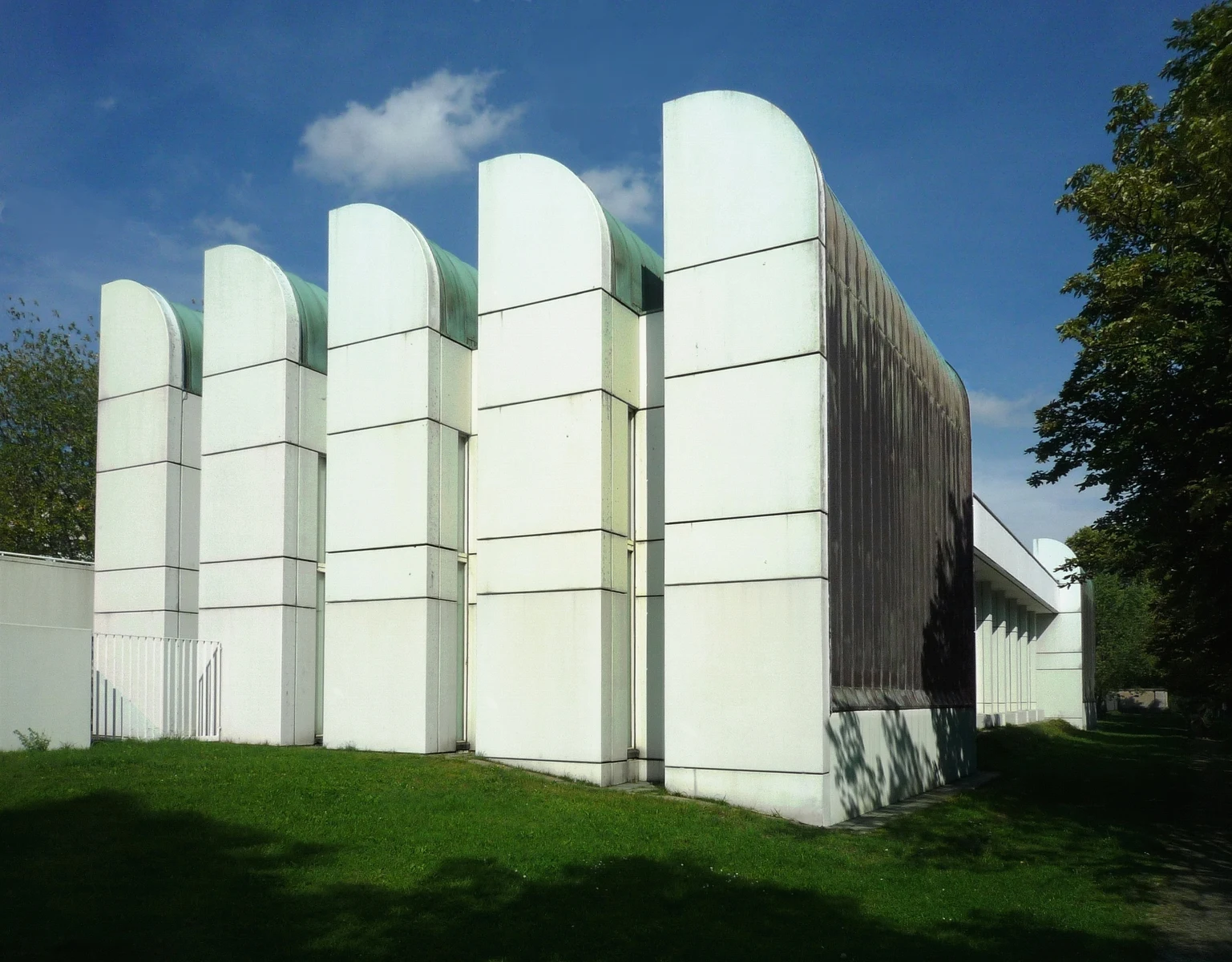
The world's largest Bauhaus collection, housed in a building designed by Walter Gropius in 1964 and completed posthumously in Berlin-Tiergarten in 1979.
The Bauhaus-Archiv holds the world's largest collection of documents, objects and works relating to the Bauhaus school — the most influential design school of the twentieth century. The building that houses it has its own layered history: Walter Gropius designed it in 1964 for a site in Darmstadt that was never realised. After his death in 1969, the design was adapted for a sloping site beside the Landwehrkanal in Berlin-Tiergarten by architect Alex Cvijanovic, and the building finally opened in 1979.
Gropius's design is recognisably late Bauhaus in its formal language: white rendered concrete, the building's profile defined by a sequence of sawtooth rooflight sheds that give the long section its distinctive silhouette. The shed roofs admit north light into the galleries — a practical solution that also gives the building its most characteristic exterior feature. The relationship between the stepped massing and the sloping garden that surrounds it is carefully handled, the building anchored to its site despite the late modification of context.
The permanent collection spans all Bauhaus workshops and masters: furniture by Marcel Breuer, metalwork from the Dessau workshops, typography, weaving, ceramics, photography and stage design, as well as a significant archive of drawings, letters and photographs. The density of material is exceptional — this is not a museum of reconstructions but of original objects, many of them fragile and rarely displayed.
Note: the building has been undergoing expansion works; check opening status before visiting. The new extension by Staab Architekten, when complete, will more than double the exhibition space.
Culture · MuseumArchitecture · Modernism
Nearby places
More in BerlinAll →
Comments
Sign in to leave a comment.
Access conditions may change. Please check current opening and access information with the venue before visiting.
Something wrong or missing?