Worth Visiting
Karłowicz Philharmonic
Barozzi/Veiga · 2014
ArchitectBarozzi/Veiga
Year2014
LocationSzczecin, Poland
Coordinates53.4292° N, 14.5580° E
TypeCulture · Performance Space, Architecture · Contemporary Architecture
StatusWorth Visiting
Sign in to save and check in to this place.
About this place
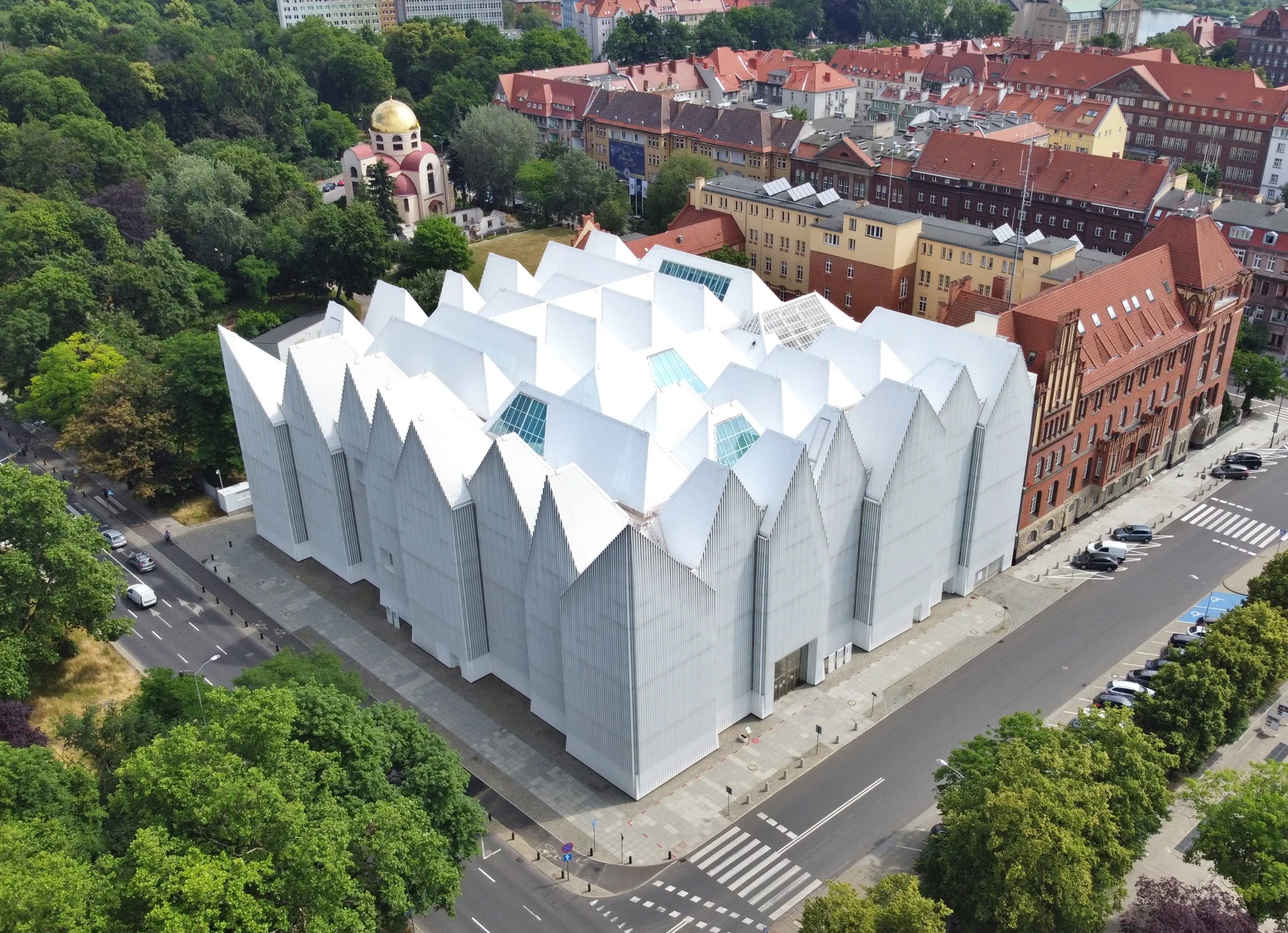
Barozzi/Veiga's Mieczysław Karłowicz Philharmonic in Szczecin — a crystalline white-faceted concert hall that won the EU Mies van der Rohe Award in 2015.
The Mieczysław Karłowicz Philharmonic in Szczecin, completed in 2014 by the Barcelona-based practice Barozzi/Veiga, is one of the most striking concert halls built in Europe in the past two decades. It won the European Union Prize for Contemporary Architecture (Mies van der Rohe Award) in 2015, the first Polish building ever to receive it.
The building occupies a historically charged site in the centre of Szczecin: the original philharmonic was destroyed during the Second World War, and the new hall was built in its place after a long period in which the city debated what to put there. Barozzi/Veiga's response is a cluster of pointed volumes clad entirely in white glazed terracotta tiles, their rooflines rising to sharp peaks that reference the gabled silhouettes of the Central European townhouses that once lined the surrounding streets. The building is at once abstract and historically allusive — the peaks read as a skyline, a memory of the city's lost fabric.
The street-level facades are largely glazed, allowing views into the foyers and making the building active at ground level in a way that concert halls rarely manage. Inside, the main auditorium is a refined, wood-panelled room of exceptional acoustic quality, its geometry controlled and warm. The foyers, by contrast, are tall and luminous, the white exterior cladding visible through the glass as a bright continuous presence.
Szczecin is not on most architectural itineraries, but this building alone justifies a detour for anyone travelling through northwestern Poland.
Culture · Performance SpaceArchitecture · Contemporary Architecture
Nearby places
More in SzczecinAll →
Comments
Sign in to leave a comment.
Access conditions may change. Please check current opening and access information with the venue before visiting.
Something wrong or missing?