Worth Visiting
Netherlands Institute for Sound and Vision
Neutelings Riedijk Architects · 2006
ArchitectNeutelings Riedijk Architects
Year2006
LocationHilversum, Netherlands
Coordinates52.2353° N, 5.1731° E
TypeCulture · Museum, Architecture · Museum Building
StatusWorth Visiting
Sign in to save and check in to this place.
About this place
A half-buried Euclidian cube wrapped in 2,244 coloured glass panels depicting Dutch TV history, housing Europe's largest audiovisual archive in Hilversum's Media Park.
The Netherlands Institute for Sound and Vision occupies a deceptively simple massing — a large Euclidian cube — whose upper half announces itself through one of the most visually arresting facades in contemporary Dutch architecture. Designed by Neutelings Riedijk Architects and opened in December 2006, the building resolves a genuinely complex brief: it must simultaneously function as a public museum, a national cultural archive, offices, an auditorium, and an audiovisual library, while keeping over 750,000 hours of film, radio, and television material in stable, climate-controlled conditions.
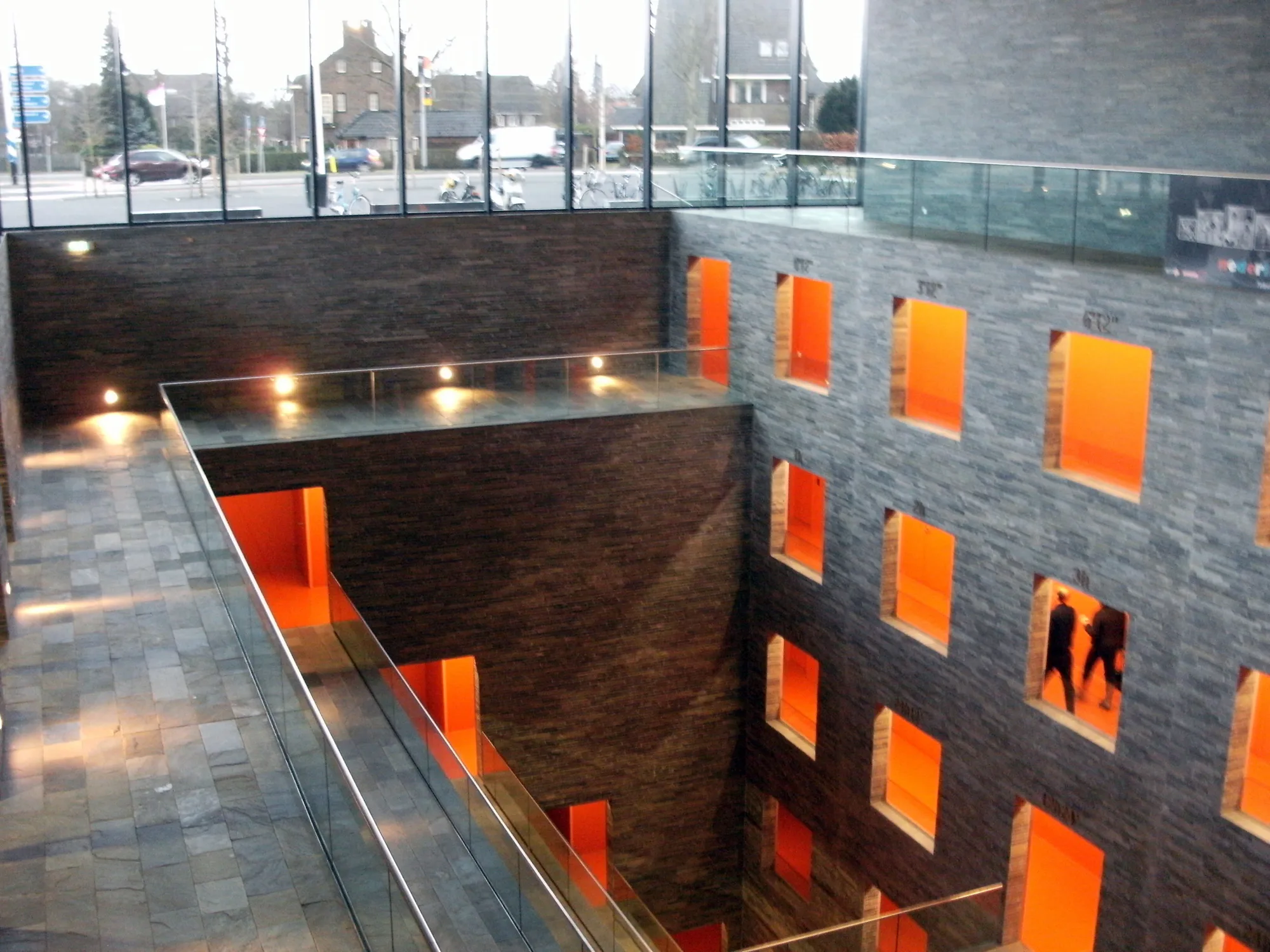
The solution is sectional. Half the building descends underground, where five subterranean levels arranged around a central canyon house the Dutch national radio and television archives in naturally regulated temperature and humidity. Above ground, the exhibition volume is an inverted ziggurat — a silver-grey mass that widens as it rises. The canyon and the ziggurat are joined by a tall public atrium spanning from 16 metres below grade to 26 metres above, which becomes the building's social and ceremonial heart.
The facade is the building's most legible gesture. Graphic designer Jaap Drupsteen translated archival stills from Dutch television history into 2,244 unique glass relief panels, each carrying its own colour pattern. The panels behave like contemporary stained glass: as daylight shifts, images of Dutch broadcasting culture appear and dissolve across the surface. The effect is both archival and alive, turning the building skin into a publicly readable index of collective memory.
The project was shortlisted for the Mies van der Rohe Award and received the Golden Pyramid Award and the Concrete Award. It remains one of the most resolved examples of how a cultural institution can fuse programme, structure, and surface into a single architectural argument.
Culture · MuseumArchitecture · Museum Building
More in HilversumAll →
Comments
Sign in to leave a comment.
Access conditions may change. Please check current opening and access information with the venue before visiting.
Something wrong or missing?