Worth Visiting
Stedelijk Museum Amsterdam
Benthem Crouwel Architects (extension) · 2012
ArchitectBenthem Crouwel Architects (extension)
Year2012
LocationAmsterdam, Netherlands
Coordinates52.3580° N, 4.8798° E
TypeCulture · Museum, Architecture · Museum Building
StatusWorth Visiting
Sign in to save and check in to this place.
About this place
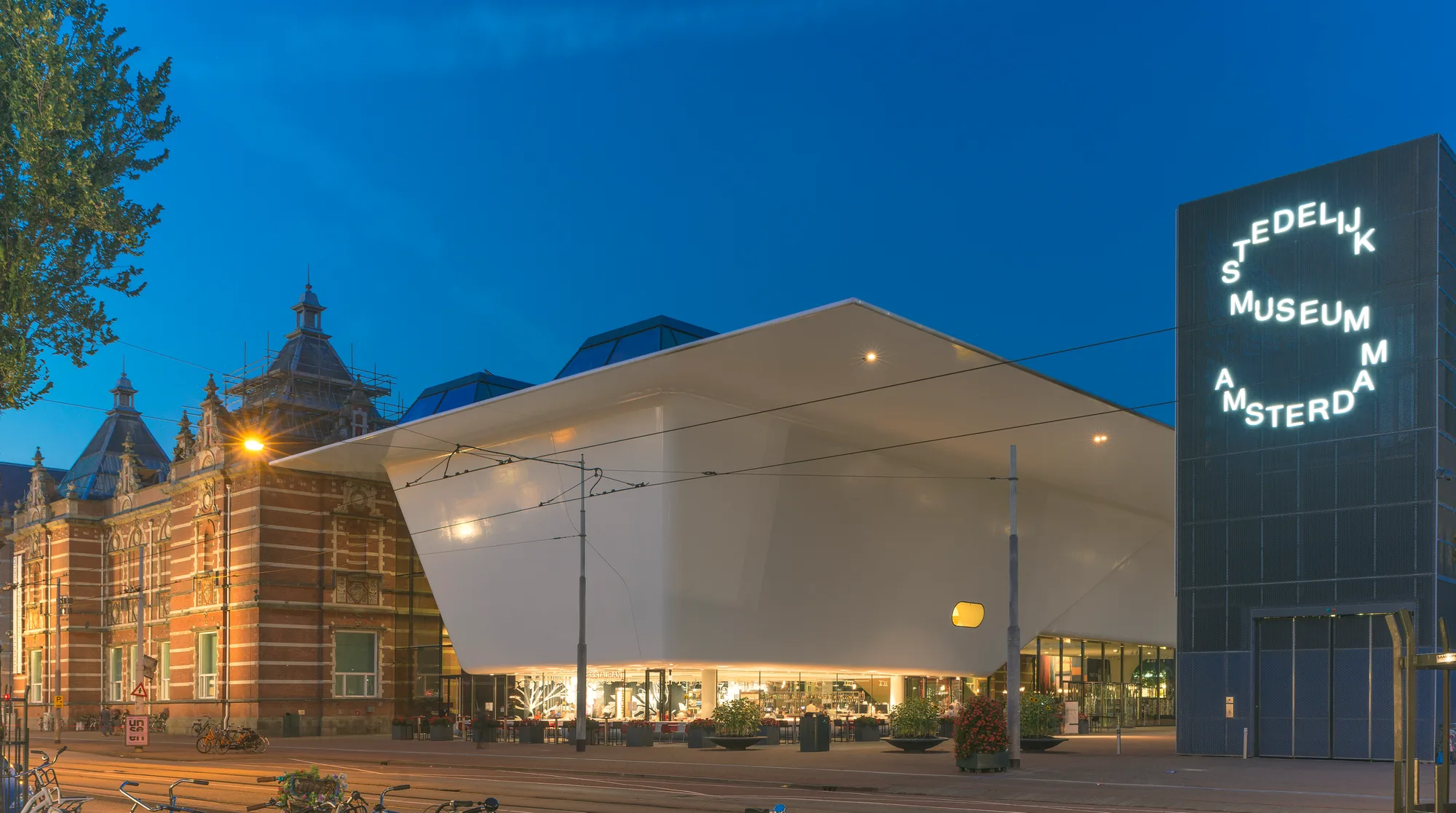
A vast white composite 'bathtub' extension by Benthem Crouwel cantilevers dramatically over the Museumplein, doubling the Stedelijk's exhibition space behind its 1895 original building.
The Stedelijk Museum, Amsterdam's principal museum of modern and contemporary art and design, occupies a Neo-Renaissance building completed in 1895 by A.W. Weissman. After decades of outgrowing that original structure, the museum commissioned Benthem Crouwel Architects to design a major extension, completed in 2012 following a long and at times controversial construction process that began with a 2004 competition win.
The result — quickly nicknamed 'the bathtub' by Amsterdammers for its smooth, curved white form — is a dramatic composite-material volume that appears to float above a glazed ground floor, cantilevering out toward the Museumplein without any visible means of support along its street-facing edge. Constructed from a synthetic Twaron-reinforced composite material more commonly associated with aerospace and marine engineering than architecture, the seamless white shell was chosen specifically to read as sculptural and futuristic against the ornate brick of the original Weissman building directly behind it, rather than attempting to blend in.
Inside, the extension roughly doubled the museum's usable exhibition space, allowing the Stedelijk to display more of its deep collection — spanning van Gogh, Mondrian, Malevich, and postwar and contemporary design alongside rotating major exhibitions. The contrast between the two structures, historic ornament fused to futurist volume, has become one of the defining architectural images of Amsterdam's Museum Quarter, standing alongside the Rijksmuseum and Van Gogh Museum on the same square.
Culture · MuseumArchitecture · Museum Building
More in AmsterdamAll →
Comments
Sign in to leave a comment.
Access conditions may change. Please check current opening and access information with the venue before visiting.
Something wrong or missing?