Visit if Near
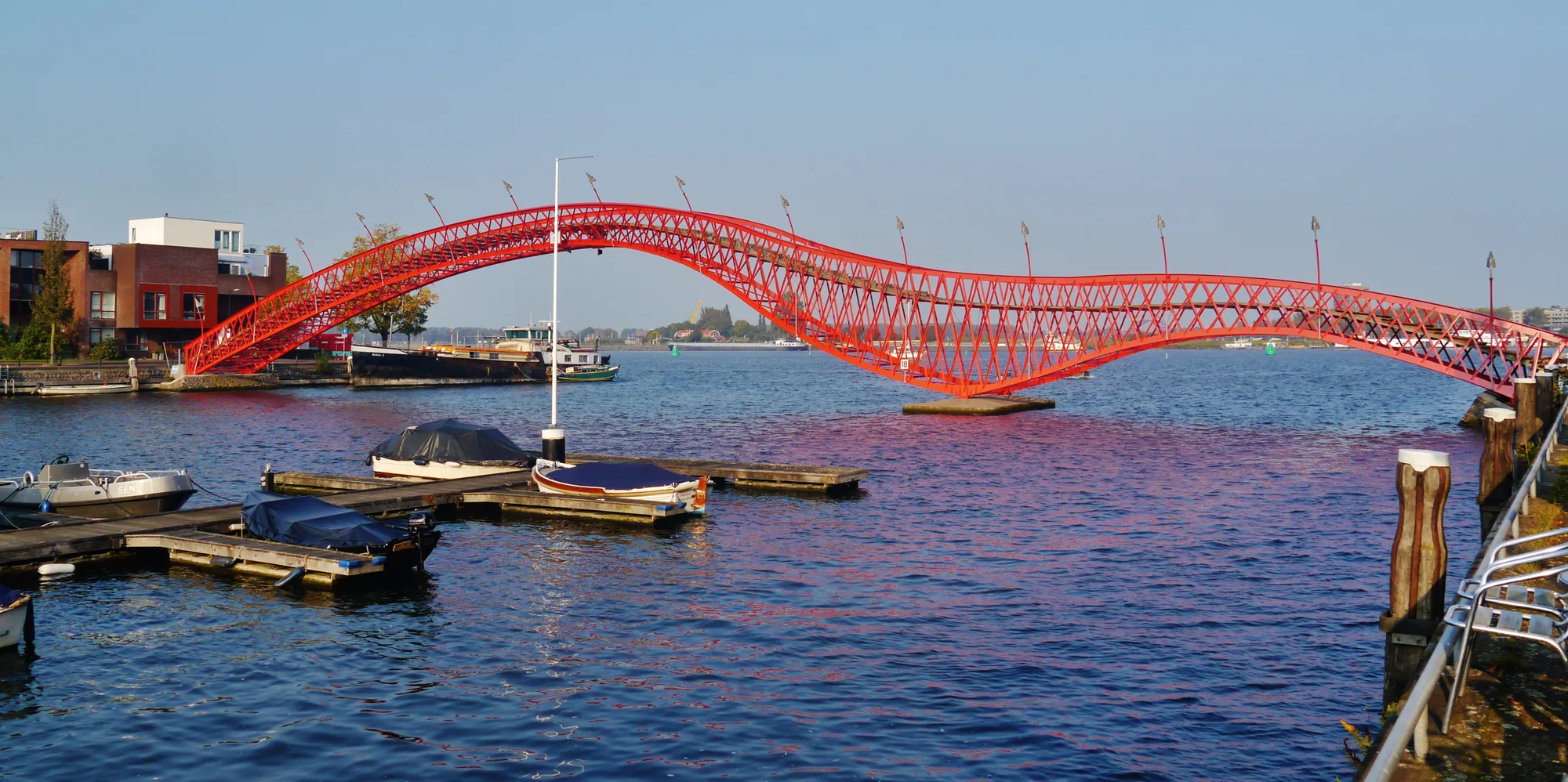
Python Bridge — Borneo Sporenburg
West 8 (Adriaan Geuze) · 2001
ArchitectWest 8 (Adriaan Geuze)
Year2001
LocationAmsterdam, Netherlands
Coordinates52.3730° N, 4.9489° E
TypeInfrastructure · Bridge, Public Space · Waterfront
StatusVisit if Near
Sign in to save and check in to this place.
About this place
Sinuous red steel footbridge by West 8 (2001), centrepiece of a landmark 2,500-unit harbour residential masterplan linking Borneo and Sporenburg peninsulas.
The Python Bridge is the most iconic element of West 8's Borneo–Sporenburg masterplan, in which Adriaan Geuze transformed two defunct industrial dockyards in Amsterdam's eastern harbour into one of the densest low-rise residential districts in Europe. The bridge spans approximately 90 metres across the Railroad basin, connecting Borneo Island to Sporenburg in a single sinuous arc clad in bright red painted steel. Its profile rises steeply enough on each bank to allow sailboats passage through the marina below, and the deck undulates in section — crossing it produces a kinetic, bodily experience rather than a simple transit.
The masterplan itself is as significant as the bridge: West 8 set a framework of low three-storey block housing at 100 units per hectare — an unusually high density for such a typology — with three large 'intrusions' by invited architects breaking the urban fabric. The Python Bridge was an essential connector but also an architectural statement, giving the new neighbourhood a recognisable identity.
The bridge won the International Footbridge Award in 2002; the overall Borneo–Sporenburg project received Harvard GSD's Veronica Rudge Green Prize in Urban Design. It remains a widely cited model for high-density urban waterfront housing.
Infrastructure · BridgePublic Space · Waterfront
More in AmsterdamAll →
Comments
Sign in to leave a comment.
Access conditions may change. Please check current opening and access information with the venue before visiting.
Something wrong or missing?