Worth Visiting
San Francesco della Vigna
Jacopo Sansovino (church), Andrea Palladio (facade) · 1570
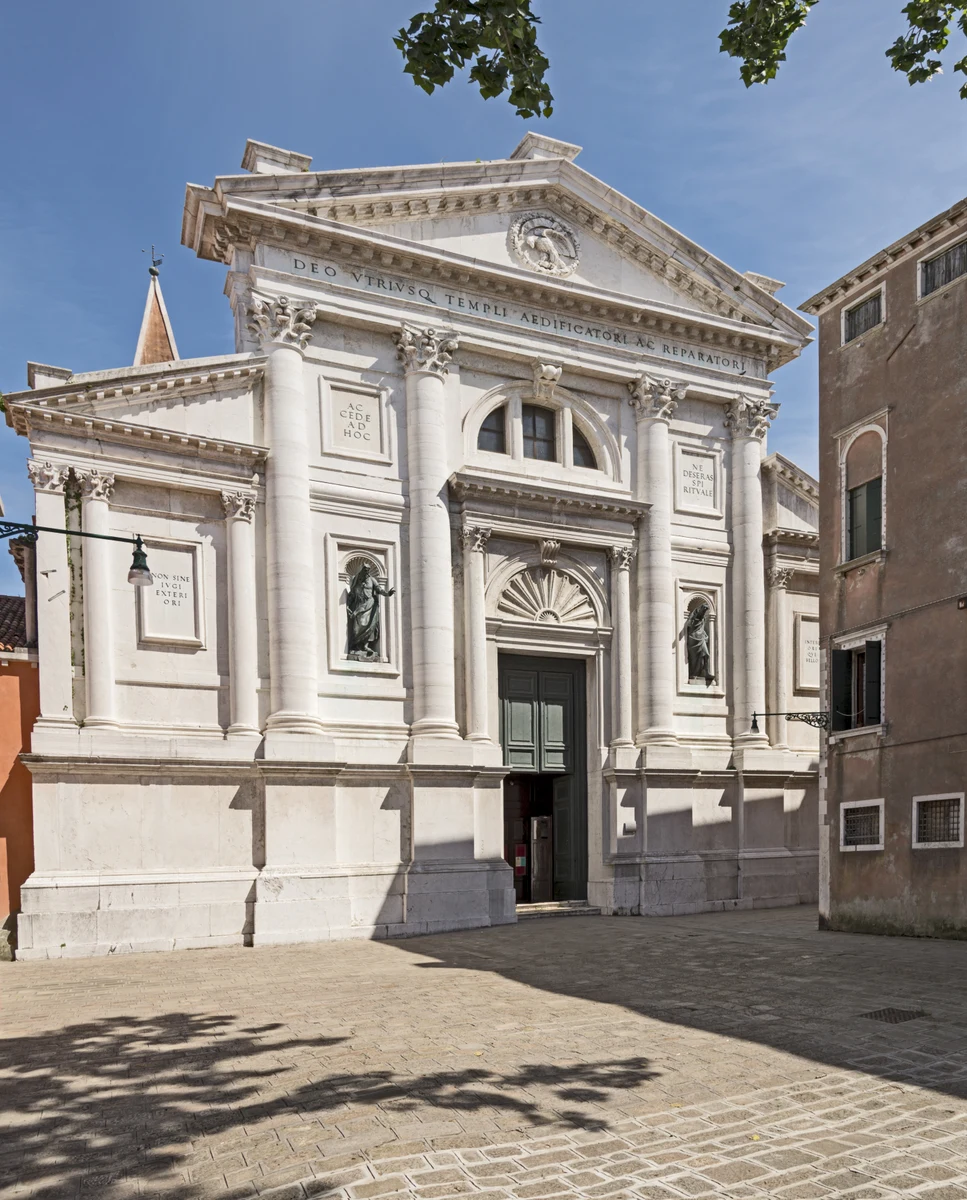
ArchitectJacopo Sansovino (church), Andrea Palladio (facade)
Year1570
LocationVenice, Italy
Coordinates45.4383° N, 12.3475° E
TypeArchitecture · Religious Building
StatusWorth Visiting
Sign in to save and check in to this place.
About this place
A quiet Franciscan church in Castello whose gleaming white marble facade — Palladio's first executed church front — set the template for his later religious architecture in Venice.
Tucked into a peaceful corner of the Castello district, a short walk from the Arsenale and well off the main tourist routes through San Marco, San Francesco della Vigna is easy to overlook — which is precisely what makes it rewarding to seek out. The church itself was designed in a sober Renaissance style by Jacopo Sansovino beginning in 1554, guided by the theological numerology of the Franciscan friar Francesco Zorzi, whose ideas about sacred proportion shaped the building's plan.
The facade, however, is Palladio's: commissioned in 1562 by patron Giovanni Grimani and completed between 1564 and 1570, it was Palladio's first executed church front and a crucial testing ground for the problem he would spend the rest of his career refining — how to apply the temple-front logic of classical antiquity to the very different massing of a Christian basilica, with its tall nave and lower side aisles. His solution here, a giant order pediment overlaid on a secondary, lower one, became the template he'd return to at San Giorgio Maggiore and the Redentore.
Compared to the crowds waiting outside those two much more famous Palladio churches across the water, San Francesco della Vigna feels almost private. The white marble facade, luminous against Castello's quiet brick streets, rewards a slow look at how a young Palladio worked out, for the first time, ideas that would define his religious architecture for the rest of his life.
Architecture · Religious Building
More in VeniceAll →
Comments
Sign in to leave a comment.
Access conditions may change. Please check current opening and access information with the venue before visiting.
Something wrong or missing?