Must Visit
Villa Savoye
Le Corbusier · 1931
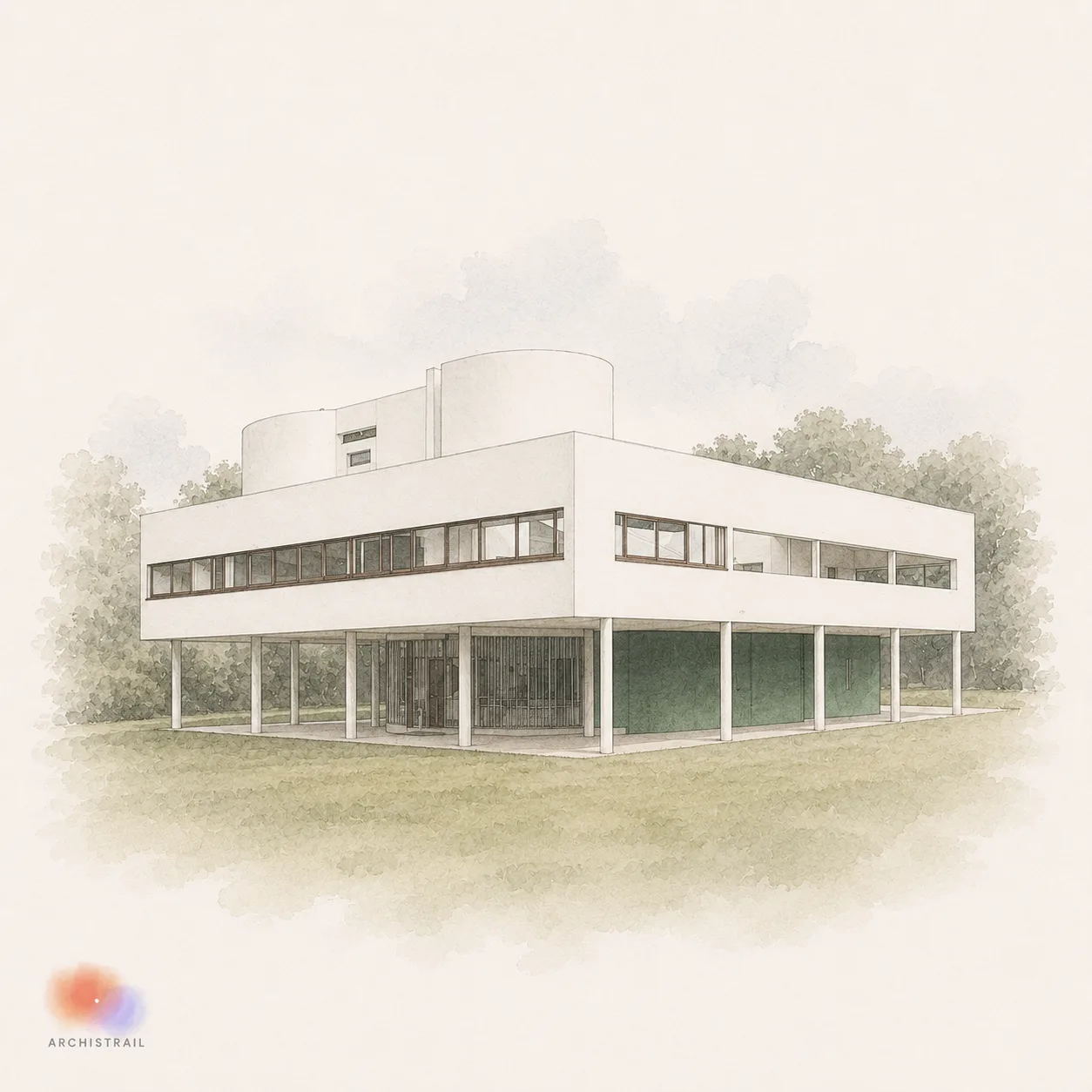
FIG. 01
ArchitectLe Corbusier
Year1931
LocationPoissy, France
Coordinates48.9244° N, 2.0283° E
TypeArchitecture · Modernism, Interior · Residential Interior
StatusMust Visit
Sign in to save and check in to this place.
About this place
Le Corbusier's 1931 white villa in Poissy — a built manifesto of the Five Points of Architecture and one of the most studied buildings of the 20th century.
Villa Savoye is the building in which Le Corbusier most completely realised his Five Points of Architecture: pilotis lifting the volume from the ground, a free plan unshackled from load-bearing walls, a free facade, horizontal windows running the full width of each elevation, and a roof garden reclaiming the footprint lost to construction. Completed in 1931 for the Savoye family as a weekend house outside Paris, it is less a home than a diagram of ideas made habitable.
The experience is spatial rather than picturesque. You arrive beneath the building, car and body passing under its lifted mass, before ascending via ramp — never stair — through the levels. The ramp is the promenade architecturale in concentrated form: movement as the organising principle, each turn revealing a new relationship between inside and outside, floor and sky.
On the roof, curved walls shelter a solarium open to the sky. The horizontal windows fill every room with an even, panoramic light, dissolving the boundary between architecture and landscape.
Abandoned after WWII and nearly demolished in the 1960s, the villa was saved by Le Corbusier himself lobbying the French government. It became a listed monument in 1965 and is now managed by the Centre des monuments nationaux. The ground-floor rooms include an informative exhibition on the building's history and Le Corbusier's broader project. Come early — the numbers are limited and the experience rewards slow attention.
Architecture · ModernismInterior · Residential Interior
Nearby places
More in PoissyAll →
Comments
Sign in to leave a comment.
Access conditions may change. Please check current opening and access information with the venue before visiting.
Something wrong or missing?