Worth Visiting
Robin Hood Gardens
Alison and Peter Smithson · 1972
ArchitectAlison and Peter Smithson
Year1972
LocationLondon, United Kingdom
Coordinates51.5093° N, 0.0138° W
TypeArchitecture · Housing
StatusWorth Visiting
Sign in to save and check in to this place.
About this place
A landmark Brutalist 'streets in the sky' housing estate by the Smithsons, largely demolished 2017–2019 despite a major preservation campaign — a section survives in the V&A's collection.
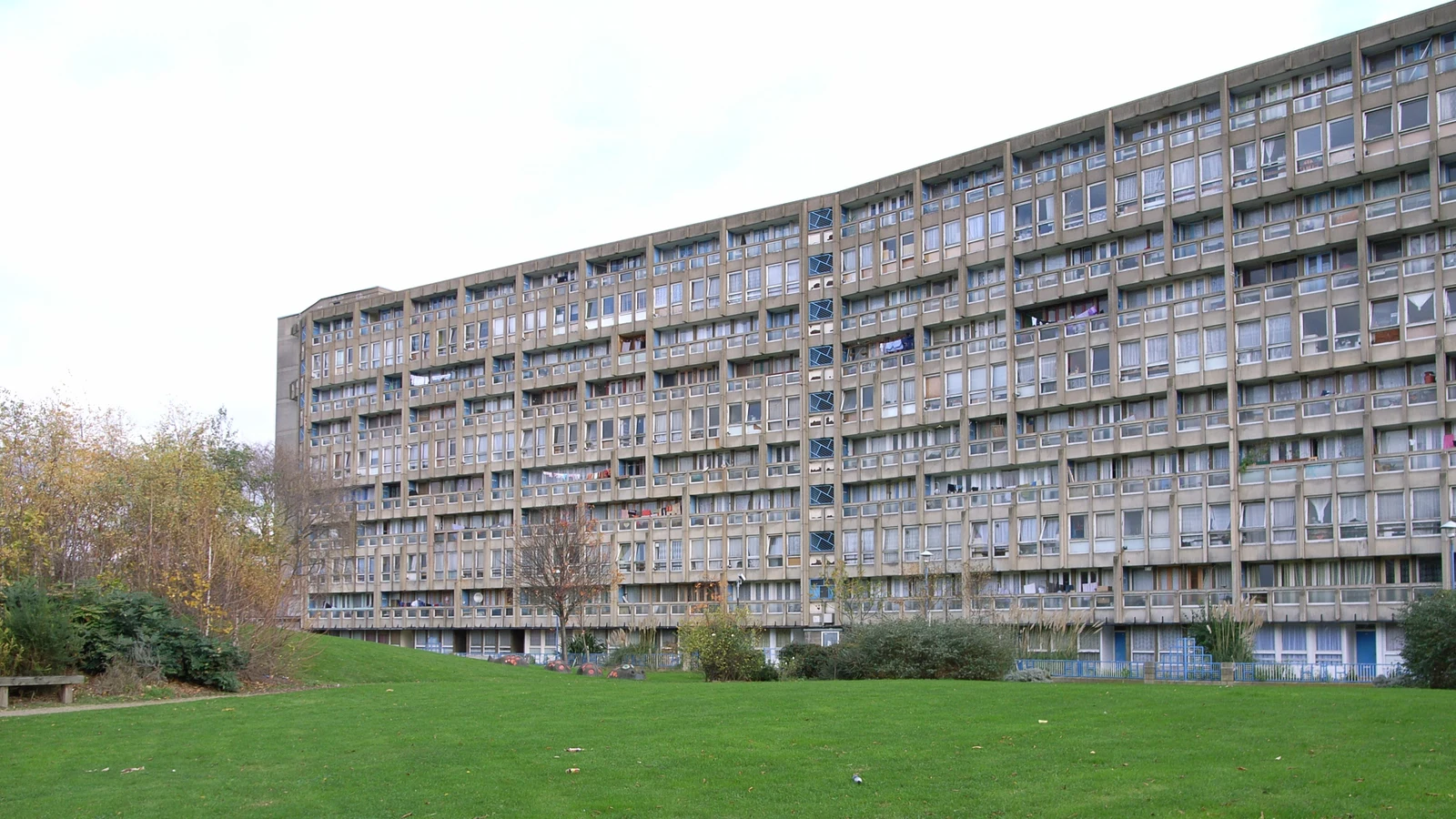
Completed in 1972, Robin Hood Gardens was Alison and Peter Smithson's largest realized housing project and the fullest built expression of their 'streets in the sky' theory — the idea that wide, open-air aerial walkways running the length of a housing block could recreate the social life and casual encounters of a traditional street, lifted above ground level. Two long, curving concrete slab blocks faced each other across a landscaped mound, deliberately turning their backs on the surrounding traffic to enclose a shared green space at the estate's center.
The building was, from early on, a lightning rod in debates about postwar social housing and Brutalist architecture more broadly — celebrated by architectural historians as an important, theoretically rigorous work, while criticized by residents and local authorities for maintenance problems, social issues, and a design that some found alienating rather than communal. A sustained campaign by architects, critics, and heritage bodies — including a formal but unsuccessful bid for listed status — failed to prevent the local council's 2015 decision to demolish the estate as part of the wider Blackwall Reach regeneration; demolition of the western block began in December 2017 and continued through 2019.
In a rare gesture of architectural salvage, a three-storey, nine-metre section of one facade — complete with a maisonette interior — was carefully removed before demolition and acquired by the Victoria and Albert Museum, first shown at the 2018 Venice Architecture Biennale and now part of the V&A's permanent collection. Robin Hood Gardens itself is now almost entirely gone, replaced by new development, but it remains one of the most discussed case studies in debates over Brutalist heritage, social housing policy, and what — and whose judgment — determines which buildings get saved.
Architecture · Housing


More in LondonAll →
Comments
Sign in to leave a comment.
Something wrong or missing?
