Visit if Near
Santa Caterina Market
Enric Miralles + Benedetta Tagliabue / EMBT · 2005
ArchitectEnric Miralles + Benedetta Tagliabue / EMBT
Year2005
LocationBarcelona, Spain
Coordinates41.3842° N, 2.1757° E
TypePublic Space · Market Space, Architecture · Adaptive Reuse
StatusVisit if Near
Sign in to save and check in to this place.
About this place
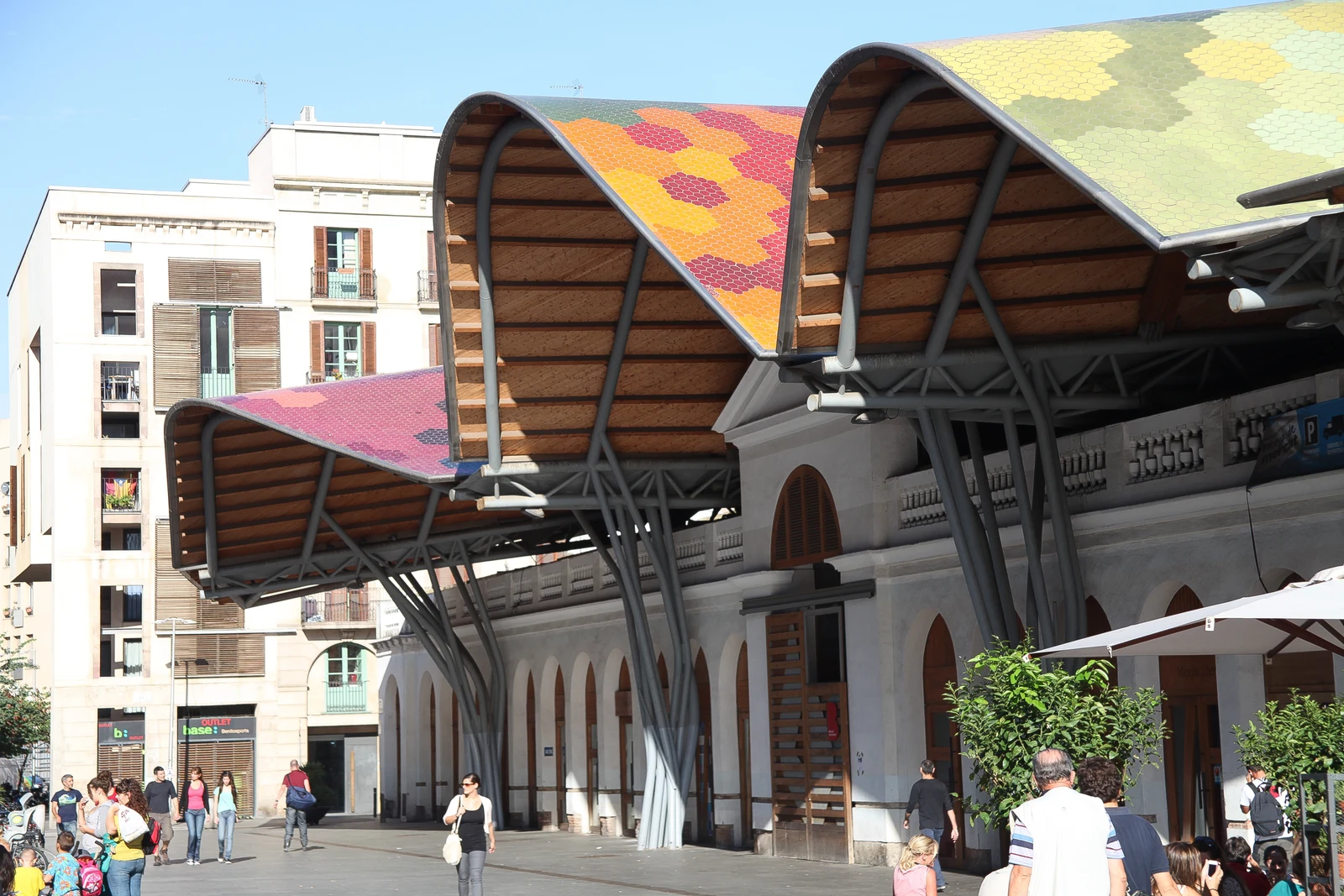
EMBT's radical renovation of a 19th-century market in Barcelona's Gothic Quarter — its undulating mosaic roof, composed of thousands of ceramic tiles in a pixelated fruit-and-vegetable pattern, is among the most vivid pieces of architecture made in Europe in the 2000s.
The Mercat de Santa Caterina is the renovation of a 19th-century covered market in the El Born district of Barcelona, completed in 2005 by EMBT — the practice of Enric Miralles and Benedetta Tagliabue. The project was begun by Miralles before his death in 2000 and completed by Tagliabue; it stands as one of the defining works of Barcelona's second great wave of architectural production, after the 1992 Olympics.
The building's exterior is dominated by its roof: an undulating ceramic surface composed of 325,000 hexagonal tiles in a pixelated mosaic representing fruits, vegetables, and mushrooms — the produce of the market below. The pattern was designed in collaboration with the ceramicist Toni Comella and derived from a photographic composition of the market's goods. The result is a roof that is simultaneously a diagram, a decoration, and a structural achievement — the undulating surface gains stiffness from its curvature, and the ceramic tiles are bonded to a steel and concrete shell that spans the market hall without interior supports.
Inside, the market functions as a working neighbourhood food market, as it has since the 19th century. The plan is partly excavated into the ground, and the archaeological remains of the medieval convent of Santa Caterina — discovered during construction — are preserved and visible beneath a glass floor in one section. The section through the building is complex and spatially rich: the roof rises and falls over the stalls, and natural light enters through carefully positioned openings in the ceramic surface.
Santa Caterina is not merely an impressive formal gesture. It is a working civic building that has remained embedded in the daily life of its neighbourhood, which is the highest standard to which architecture in public programmes can be held.
Public Space · Market SpaceArchitecture · Adaptive Reuse
Nearby places
More in BarcelonaAll →
Comments
Sign in to leave a comment.
Access conditions may change. Please check current opening and access information with the venue before visiting.
Something wrong or missing?