Must Visit
The Feuerle Collection
John Pawson · 2016
ArchitectJohn Pawson
Year2016
LocationBerlin, Germany
Coordinates52.5006° N, 13.3782° E
TypeCulture · Foundation, Architecture · Adaptive Reuse, Interior · Exhibition Interior
StatusMust Visit
Sign in to save and check in to this place.
About this place
A private museum of Southeast Asian antiquities and contemporary art inside a WWII telecommunications bunker in Kreuzberg, converted by John Pawson in 2016.
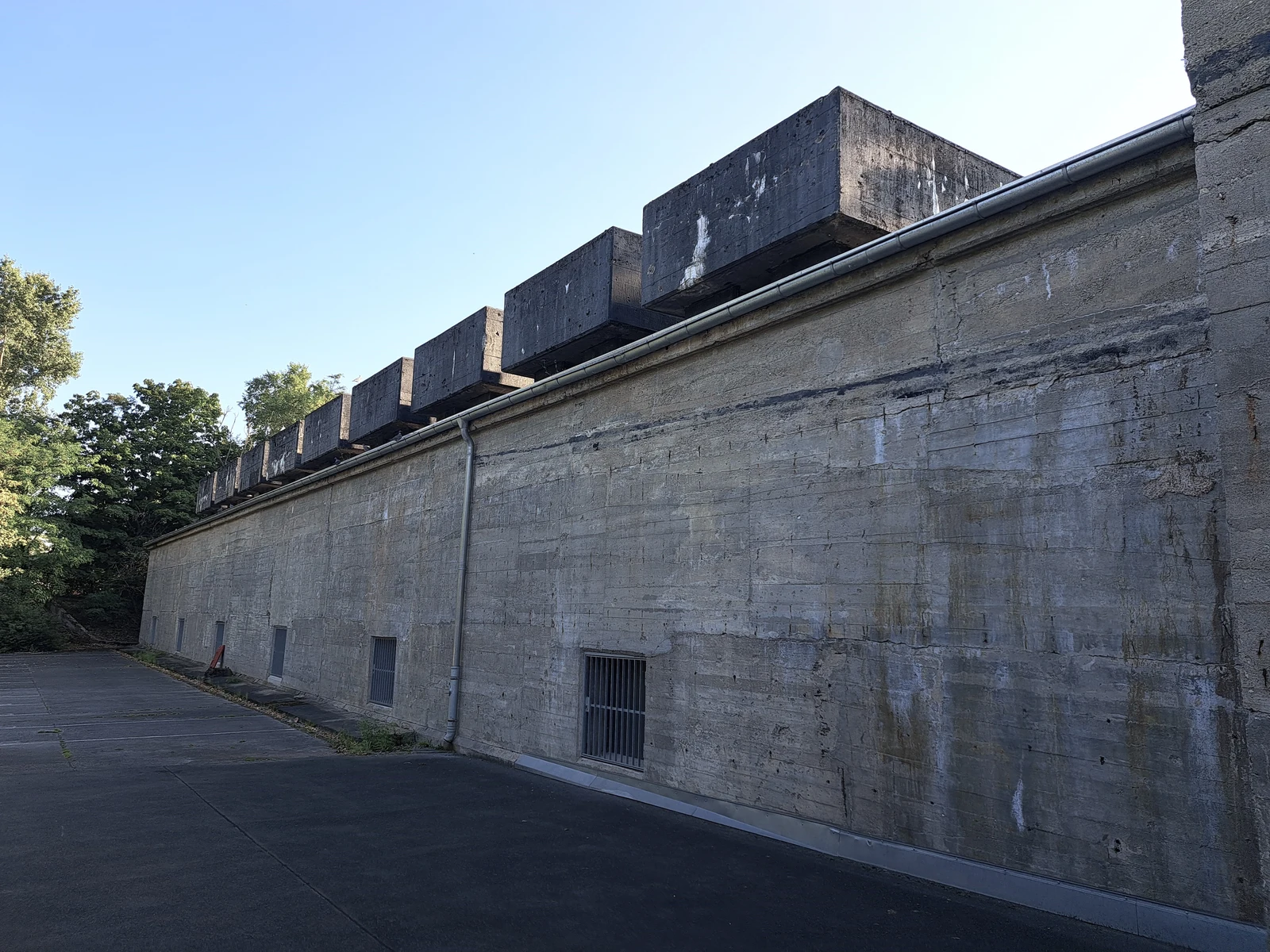
The Feuerle Collection occupies one of Berlin's most unlikely spaces: a WWII-era telecommunications bunker on the Landwehrkanal in Kreuzberg, its metre-thick concrete walls intact, its history still legible in the fabric of the building. John Pawson was commissioned by collector Désiré Feuerle to convert the structure into a permanent home for his collection, and the result — opened in 2016 — is among the most spatially singular museums in Europe.
Pawson's intervention is characteristically restrained. The bunker's raw concrete shell is preserved almost entirely; where new elements are introduced — threshold zones, lighting rigs, a monumental stone table by Pawson himself — they are precise and minimal. The sequence of descent is important: visitors pass through a decompression chamber before entering the collection spaces, a transition that enforces a perceptual shift before the artworks are encountered. The lighting is dim throughout, tuned to the conservation requirements of the Khmer sculptures and Tang dynasty objects that form the core of the collection, and the effect is one of extreme atmosphere — part archaeological site, part meditation space.
The collection itself spans several thousand years: Cambodian and Southeast Asian antiquities sit alongside works by John Cage and Ceal Floyer, the pairings governed by Feuerle's long-standing interest in silence and resonance across cultures. The juxtapositions are rarely forced and often quietly arresting.
Visits are by appointment only and limited in number, which preserves the quality of the experience but requires planning. The bunker's exterior — a massive unremarkable concrete block between a canal and a road — gives no indication of what is inside.
Culture · FoundationArchitecture · Adaptive ReuseInterior · Exhibition Interior
Nearby places
More in BerlinAll →
Comments
Sign in to leave a comment.
Access conditions may change. Please check current opening and access information with the venue before visiting.
Something wrong or missing?